


FINTRAC oversight for money service businesses (MSBs) in Canada has increased significantly in recent years. The organization is closely monitoring reporting entities and issuing administrative monetary penalties (AMP) against businesses that violate the Proceeds of Crime and Terrorist Financing Act (PCMLTFA).
In October 2025, FINTRAC confirmed issuing the highest AMP of all time against a virtual currency exchange. The penalty made waves in the fintech industry, highlighting the importance of having a qualified money laundering reporting officer (MLRO). Learn more about AMPs and their implications in our post below.
What is an Administrative Monetary Penalty?
An administrative monetary penalty is a financial penalty imposed by FIINTRAC for violations of the PCMLTFA. The organization aims to encourage compliance with anti-money laundering (AML) regulations through AMPs. These penalties are classified into:
- “Minor Violations:” $1 to $1,000 per violation
- “Serious Violations:” $1 to $100,000 per violation
- “Very Serious Violations:” $1 to $500,000 per violation
Businesses that commit multiple violations may face cumulative penalties that exceed the per-violation limits. Strict compliance with FINTRAC regulations can help you reduce the risk of facing AMPs for non-compliance.
Who Issues Administrative Monetary Penalties in Canada?
FINTRAC issues administrative monetary penalties for non-compliance with PCMLTFA. A few violations for which the organization issues AMPs include:
- Failure to report suspicious transactions
- Failure to keep records of transactions for at least five years
- Failure to report large cash or virtual currency transactions
- Failure to develop and implement strict AML policies
- Failure to comply with Ministerial Directives
The agency requires all MSBs to appoint a qualified Money Laundering Reporting Officer (MLRO) to oversee internal compliance measures. An MLRO assists with developing and implementing strong AML policies to combat transactions involving financial crimes.
Why Did FINTRAC Issue the Highest Administrative Monetary Penalty Against Xeltox?
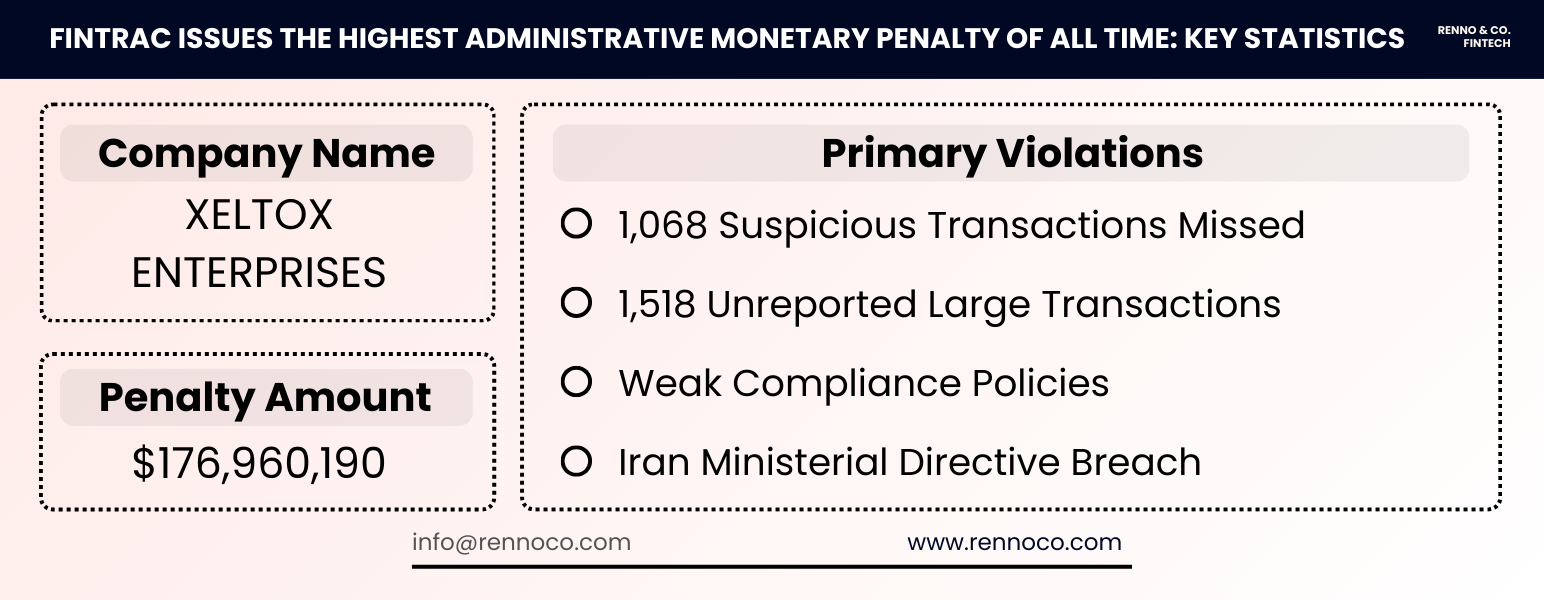
On 17th July 2025, FINTRAC proposed to issue an AMP against Xeltox Enterprises, a virtual currency transaction service provider in British Columbia. The agency had been investigating the business for non-compliance with PCMLTFA and related regulatory requirements.
Xeltox Enterprises was found to have violated six regulations under the PCMLTFA on 2,593 occasions. These included:
- Failure to report 1,068 suspicious transactions involving criminal activities
- Failure to comply with a Ministerial Directive related to transactions involving Iran
- Failure to develop and implement compliance policies that a senior MLRO approved
- Failure to recognize the risk of money laundering and terrorist financing offences
- Failure to submit changes to business information on 4 different occasions
- Failure to report 1,518 large virtual currency transactions
After reviewing the findings of the compliance assessment, FINTRAC confirmed an AMP of $176,960,190 against the virtual currency business in October 2025.
How to Protect Your Fintech Business From FINTRAC Penalties?
Appointing a money laundering reporting officer, also known as a compliance officer, is mandatory for all MSBs in Canada. The officer helps you maintain compliance with FINTRAC regulations. Here are the top ways in which an MLRO can protect your business:
- Implements FINTRAC-Compliant AML Policies
FINTRAC requires all MSBs to develop and implement a comprehensive AML program for compliance. Businesses must monitor and update their policies to comply with evolving fintech regulations. Companies that don’t have an adequate program may be subject to AMPs.
A money laundering reporting officer can help you develop a robust AML compliance program for your business. MLROs stay informed of the latest regulatory updates and use them to create strong internal policies. Skilled officers such as those at Renno & Co. Fintech also assist with implementing know-your-customer (KYC) policies.
- Conduct Regulatory and Operational Risk Assessments
Assessing operational risks ensures that entities understand their exposure to money laundering and terrorist financing vulnerabilities. Businesses must also have a risk management framework in place as per FINTRAC and Bank of Canada regulations. Failing to do so can lead to a “Serious Violation” under the administrative monetary penalty program.
An MLRO can help you identify business areas that may be susceptible to exploitation for money laundering. Your compliance officer can implement measures to mitigate different risks and ensure compliance with FINTRAC regulations.
- Monitors Transactions and Reports Suspicious Activities
FINTRAC requires all registered MSBs to submit suspicious transaction reports (STRs) for eligible transactions. The reasonable grounds to suspect and submit a STR include:
- Intuition that the transaction is for money laundering or terrorist financing
- Probability with a set of facts that prove or support suspicion of money laundering and terrorist financing
A money laundering reporting officer can train your employees to identify suspicious transactions. MLROs also assist with submitting legally valid STRs to FINTRAC.
- Fulfills Record-Keeping Requirements
Reporting large cash or virtual currency transactions is one of the key responsibilities of an MLRO. All MSBs must report transactions exceeding $10,000 or more to FINTRAC within 15 days of processing the payment. Failure to do so can lead to a “Minor Violation” administrative monetary penalty.
Experienced MLROs in Canada update themselves with the latest FINTRAC reporting requirements and fulfill them diligently. They identify large-value transactions and submit required reports within the legal deadline to avoid non-compliance.
FAQs
What Happens if I Don’t Comply With FINTRAC?
Money service businesses, cheque cashers, and virtual currency exchanges that don’t comply with FINTRAC are subject to penalties. These may include administrative monetary penalties, public disclosures, and imprisonment. Consequences for FINTRAC non-compliance depend on the severity of the violation.
What are the Maximum Penalties That FINTRAC can Impose?
The maximum administrative penalty FINTRAC can impose for an MSB is $500,000 per violation for an entity. This is referred to as a “Very Serious Violation” AMP. If your business commits multiple PCMLTFA offences, the total sum of violations may exceed $500,000.
What is the FINTRAC Notice of Violation?
FINTRAC issues a ‘Notice of Violation’ to reporting entities that violate regulatory requirements under the PCMLTFA. The document outlines the entity name, penalty amount, list of violations committed, and information for the company owner to make representations to FINTRAC’s CEO.
How Can I Avoid Administrative Penalties in Canada?
You can reduce the chances of facing administrative monetary penalties by hiring an experienced money laundering reporting officer. An MLRO can evaluate your AML program, assess risks, and fulfill FINTRAC reporting requirements.
Partner With Renno & Co. Fintech to Navigate FINTRAC Regulations and AMPs
FINTRAC has been closely monitoring businesses for money laundering and terrorist financing offences. Administrative monetary penalties are issued against MSBs and virtual currency exchanges that violate fintech regulations.
With the help of a skilled MLRO from Renno & Co. Fintech, you can reduce the risk of facing an AMP. Our team assists with developing AML policies, risk management frameworks, and meeting FINTRAC reporting requirements. If you wish to learn more about how our compliance officer can help you, please request a consultation.
Ready to get started?
Talk To UsBook a Free Consultation
Speak with our fintech legal advisor
about your registration


