


Do you or your client want to start a fintech or payment company or expand into the fintech or payment space?
To get started, you'll need to do a few things - like figure out your target market, get the right tech in place, and get access to banking. But before you can start your operations, you'll almost certainly have to get licensed.
Licensing can be an enormous pain, and companies can spend years trying to get registered.
Thankfully, it doesn't have to be that challenging. There are a few reputable jurisdictions in the world where you can get licensed much more easily.
For a lot of companies, we recommend Canada.
Deciding Where to Get Licensed
Deciding where to get licensed is not an easy decision - you'll want to consider a number of important factors, including:
- Where you're Located: if all or most of your staff are located in country X, then country X's regulators may expect you to obtain a payment license in country X.
- Where your Clients are Located: sometimes, if you advertise or provide substantial services to clients in country Y, country Y's regulators may expect you to register in country Y.
- Where you can get Banked: you'll need to get good banking rails in order to provide your payment services. For instance, many banks and neo-banks will not bank you if you're registered in an ill-reputed country.
- Cost & Timeline: getting a payment license costs money and takes time. In some places, it may take years and cost you hundreds of thousands of dollars (and there's no guarantee you'll succeed). High costs and timelines won't make sense for many early-stage companies. They also won't make sense for many folks that need to test out a (new) payment product before committing substantial resources to the project.
- What you can do with the license: licenses/registrations come in different shapes and sizes - they vary in the scope of activities they allow you to perform. For instance, both a European EMI and Canadian money service business ("MSB") will allow you to provide a variety of fiat payment services. The MSB, however, will also allow you to provide certain crypto services. The EMI does not give you such an ability - you'll usually need to obtain an additional Virtual Asset Service Provider ("VASP") license to do that.
Canada: an Ideal Destination to get Licensed!
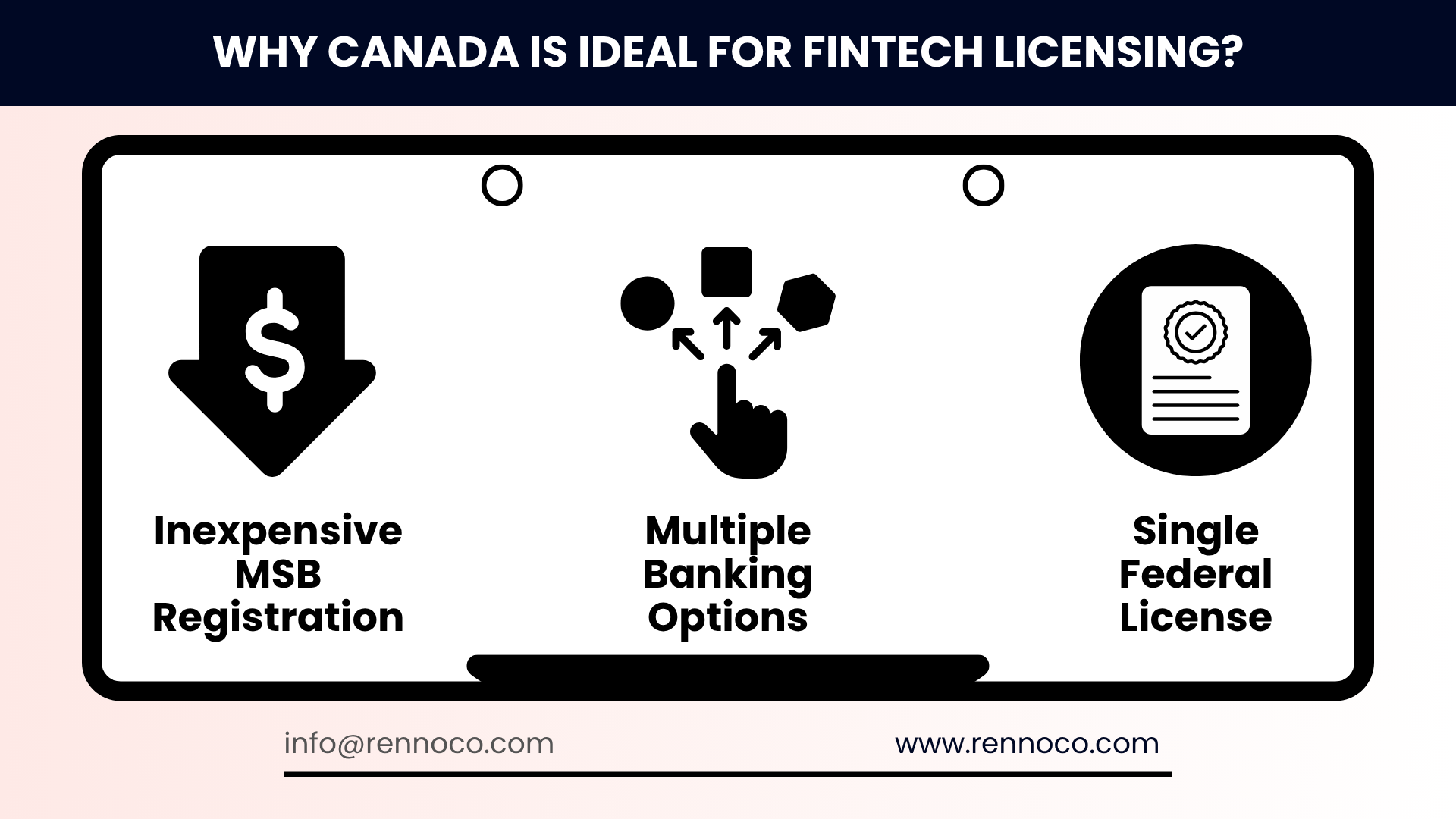
Canada has become a premier destination for fintech businesses over the past couple of years, especially for businesses from Europe and Africa. Here are some reasons why Canada may be a great choice for you or your clients:
- MSBs are Inexpensive and Fast: The MSB registration (Canada's current payment "license") process is quick - it takes about 5-6 months from start to end. We charge between $9,500 - $11,500 USD to get you MSB registered from A-Z, including preparing your Canadianized anti-money laundering (AML) policies. Getting an EMI - on the other hand - can take years and costs $100,000 +.
- MSBs can get Good Banking: there are a number of reputable EMIs, neo-banks and banks in Europe, Canada and the US that will provide banking services to Canadian MSBs. These bank accounts can give you an IBAN account and allow you to facilitate payments using SWIFT, SEPA, Interac e-transfer, Faster Payment, and other local payment methods.
- MSBs Passport into Foreign Countries: we are seeing more and more clients obtaining Canadian MSBs to passport into foreign markets (especially into Europe). There are certain safeguards you need to take to ensure your passporting strategy does not trigger local payment licensing or legal requirements - we can help with that!
- MSBs are Versatile: with an MSB, you can provide a host of payment, currency exchange, remittance, and e-wallet services. In addition to this, you can also provide certain crypto exchange, crypto gateway, and crypto remittance services. In a sense, the MSB gives you the functionality of an EMI combined with a VASP.
Here's a strategy we're seeing deployed effectively:
- European founders want to test out their product in the European market, but it's too expensive and time-consuming to get sufficient licenses in Europe to test out their product. So... they set up a company in Canada, get MSB registered, obtain bank accounts with European EMIs and other payment service providers, and use this infrastructure to service markets in Europe and abroad.
- African founders want to facilitate cross-border remittances from Canada, Europe and abroad into African countries. They need European and other foreign banking rails in order to do this - which is hard to come by with an African-registered company. So... they set up a company in Canada, get MSB registered, and get access to good banking rails to facilitate their cross-border remittance business.
RPAA - an Improved Registration Regime
Payment and fintech companies in Canada now have to register as "Payment Service Providers" ("PSPs") under the Retail Payment Activities Act ("RPAA"). Registration opened in November 2024 and the transition window for businesses already operating in Canada closed in September 2025. PSP registration with the Bank of Canada is now mandatory for all payment service providers in the country.
While MSB regulations are aimed at ensuring that payment companies aren't used to launder money, PSP regulations are aimed at ensuring that payment companies are run properly.
Luckily, MSB and PSP requirements that apply to Canadian payment companies are still less onerous than those in comparable jurisdictions like the EU, Singapore, the UK, and the US.
- In Canada, you can provide a host of virtual asset services with your PSP + MSB without the need for an onerous VASP license.
- PSP registration is straightforward compared to similar licenses such as the EMI or VASP in Europe.
- There are no minimum capital requirements for PSPs.
We believe the RPAA regime makes Canada an even more ideal destination for your payment operation.
When you operate in Canada, you are:
- Operating in a reputable jurisdiction with meaningful payment regulations
- Subject to a regulatory regime that is lighter touch than Europe and other jurisdictions
- Able to access lots of high-quality banking options
2026 Regulatory Landscape Update
Canada's payment and fintech regulatory landscape has evolved quickly ever since the RPAA came into force. Here's what you must know in 2026:
RPAA is now Mandatory
When RPAA registrations opened in 2024, payment service providers already operating in the country had to apply for registration and fulfill the transition period requirements. However, the transition window ended in September 2025.
Any PSP that didn't apply for Bank of Canada RPAA registration between 2024 and 2025 must now halt operations and register before offering retail payment activities. The Bank of Canada also launched its public PSP Registry in October 2025 so customers and banking institutions can easily distinguish between compliant and non-compliant businesses.
Open Banking, Phase 1 is Moving Towards Launch
Canada's Consumer-Driven Banking framework took a major step forward when Bill C-15 received Royal Assent on March 26, 2026, formally establishing rules for accredited data-sharing, consent, and an express prohibition on screen scraping.
Phase 1 (read-access APIs, letting consumers securely share account information with accredited providers) is targeted for launch in the later half of 2026, though the Bank of Canada.
However, the Bank of Canada has publicly announced that it has not yet confirmed an exact launch date. Phase 2 (write access, including payment initiation) is targeted for mid-2027.
The Real-Time Rail (RTR) is Targeted for Q3 2026 Launch
Open Banking's phase 2 involves a crucial infrastructure called the real-time rail (RTR). Payments Canada is currently testing the system for its resilience and capability to handle millions of transactions. It is expected that the system will roll out in late 2026, paving the path for phase 2 of Open Banking, which is expected to launch in 2027.
AML Amendments under the Budget 2025 Implementation Act
Royal Assent on March 26, 2026 introduced a higher Administrative Monetary Penalty (AMP) framework with a statutory requirement that AML compliance programs be "reasonably designed, risk-based, and effective," mandatory compliance agreements whenever an AMP is issued, and a new stand-alone "compliance order" enforcement tool.
The Act also enacts the Stablecoin Act, which will require stablecoin issuers serving Canadians to register with FINTRAC as MSBs dealing in virtual currency once the implementing regulations are published.
RPAA: How to Register MSB in Canada?
To register your MSB in Canada and operate as a PSP under the RPAA, you must register with the Bank of Canada. Visit the PSP Connect portal developed by the bank for registration ease. Create an account on the platform and start your application by filling out key business details.
Upon submitting the application, you must pay a non-refundable fee of $2,500 so that the Bank of Canada can start reviewing your application. Once they approve your RPAA registration, your business will appear in the PSP registry.
Note that if your business offers money services, such as issuing money orders, along with retail payment activities, you must complete FINTRAC MSB registration as well. To register your MSB with FINTRAC, you must visit their website and submit a pre-registration form.
The agency will respond to your request by sending you the MSB registration form. Fill out the key details and attach relevant documents, such as a business incorporation certificate, to submit a complete application. FINTRAC will review your application and offer a response in 5 to 6 months.
Once your registration is approved, FINTRAC will list you on its MSB Registry, which is a public database containing names of registered MSBs and their current license statuses.
FAQs
What is RPAA Registration in Canada?
In Canada, payment service providers (PSPs) must register with the Bank of Canada in accordance with the RPAA in order to meet federal compliance requirements. To operate lawfully in the nation and combat crimes related to finance, compliance with the act is crucial.
What is MSB Registration in Canada?
Money service businesses in Canada are required to register with FINTRAC under the Proceeds of Crime (Money Laundering) and Terrorist Financing Act (PCMLTFA) if they offer qualifying services. These services may include money transfers, issuing money orders, cashing cheques, and more.
What is Canada's Open Banking Framework?
Canada's Consumer-Driven Banking framework lets consumers securely share financial data with accredited providers via APIs. Bill C-15 received Royal Assent on March 26, 2026, establishing rules for accredited data-sharing, consent, and prohibiting screen scraping. The legislation formally amended Canada's financial frameworks, including key provisions regarding the RPAA.
How often do you have to renew MSB and PSP Registrations?
MSB registrations must be renewed with FINTRAC every two years. PSP registrations don't expire the same way but require annual reporting to the Bank of Canada under the RPAA.
How we can Help
We are the premier fintech and crypto-focused law and compliance firm in Canada - and the only one that integrates law and compliance. We can help you get MSB registered and help you remain compliant once you're registered.
Our team can help you with PSP registration as well in 2026. We are also well-connected with bank account providers in Canada and abroad with a history of servicing Canadian-registered payment companies.
Interested in learning more? Connect with Pouya Makki (Head of Fintech Practice & Legal Counsel at Renno & Co):
- Via email at: pouya@rennoco.com
- Via LinkedIn
Disclaimer: This content is for informational purposes only and does not constitute legal advice.
Ready to get started?
Talk To UsBook a Free Consultation
Speak with our fintech legal advisor
about your registration


