


Canada's anti-money laundering regime continues to evolve in 2026. Understanding FINTRAC penalties is no longer optional for money service businesses (MSBs) and payment service providers (PSPs).
Oversight and enforcement actions under the Proceeds of Crime (Money Laundering) and Terrorist Financing Act (PCMLTFA) have increased significantly. As a result, FINTRAC penalties for non compliance have grown in both frequency and value. If you wish to learn more about these penalties, read our guide below.
What are FINTRAC Penalties?
FINTRAC is a Canadian regulatory organization that oversees compliance with anti-money laundering and anti-terrorist financing laws. All reporting entities, including MSBs, must follow the rules set out by the agency.
Any company that fails to meet regulatory requirements may face a penalty issued by FINTRAC. These penalties encourage compliance and protect Canada's financial system.
Types of FINTRAC Penalties for Non Compliance
FINTRAC primarily imposes AMPs for regulatory violations. In cases of serious non-compliance, the agency may refer the matter to law enforcement, which may result in criminal prosecution. Let's look at them in more detail:
Administrative Monetary Penalties (AMPs)
AMPs are financial penalties that apply when MSBs, PSPs, and other fintechs breach FINTRAC regulations. Entities are named publicly when an AMP is issued. The agency also mentions the type of violation they're facing, along with the penalty amount, in the public notice.
FINTRAC classifies regulatory violations for administrative monetary penalties as:
- Minor: $1 to $1,000 per violation
- Serious: $1 to $100,000 per violation
- Very Serious: $1 to $100,000 per violation for an individual
- Very Serious: $1 to $500,000 per violation for an entity
The amount of the penalty mainly relies on the severity of the violation and the number of contraventions the MSB has committed.
Criminal Penalties
Some cases require stricter punishment than a financial penalty. FINTRAC reports such MSBs to law enforcement so that relevant investigations can take place.
If the federal court finds the reporting entity guilty of criminal non compliance, the business will be liable to:
- Summary conviction: a fine not exceeding $250,000 (for individuals) or $1,000,000 (for entities) and/or maximum imprisonment of two years less a day
- Indictment: a fine not exceeding $500,000 (for individuals) or $2,000,000 (for entities) and/or maximum imprisonment of five years
Criminal penalties may also lead to revocation of MSB registration, depending on the case circumstances and harm done.
How are FINTRAC Penalties for Non Compliance Determined
FINTRAC performs thorough investigations and considers different factors before determining a specific penalty. These include:
Nature of the Violation
The agency evaluates whether the issue is administrative or systemic. Failure to report suspicious transactions is treated more seriously than minor record errors.
Harm to Regulatory Objectives
Regulators assess whether the violation undermined Canada's AML framework. If greater harm is done, the potential for FINTRAC penalties increases significantly.
Compliance History
MSBs with repeat violations are more susceptible to law enforcement exposure and criminal charges. A history of prior notices of violation also leads to increased FINTRAC fines for MSB non compliance.
Corrective Action
Prompt remediation may reduce enforcement severity. Failure to maintain an effective AML compliance program or to conduct required periodic effectiveness reviews may increase the risk of penalties.
FINTRAC Penalties: Key Statistics to Know in 2026
Recent fiscal years have seen tens of millions of dollars in administrative monetary penalties. Enforcement actions and public notices of violation have increased in frequency. Here are some key statistics you must know about FINTRAC penalties for non compliance:
4 FINTRAC Penalties Issued Between 1st January 2026 to 12th February 2026
Within the first six weeks of 2026, FINTRAC has issued four penalties publicly. These punishments are spread across real estate and money service business sectors, including:
- A Windsor-based real estate brokerage was fined $107,250 for four violations
- A multi-location Ontario brokerage was fined $148,912.50 for one violation
- A Montréal-based MSB was fined $224,235 for five violations
- A Markham-based MSB was fined $24,750 for one violation
Some of these reporting entities have appealed to the federal court, demonstrating that enforcement actions may lead to lengthy legal proceedings.
30 FINTRAC Penalties Issued in 2025
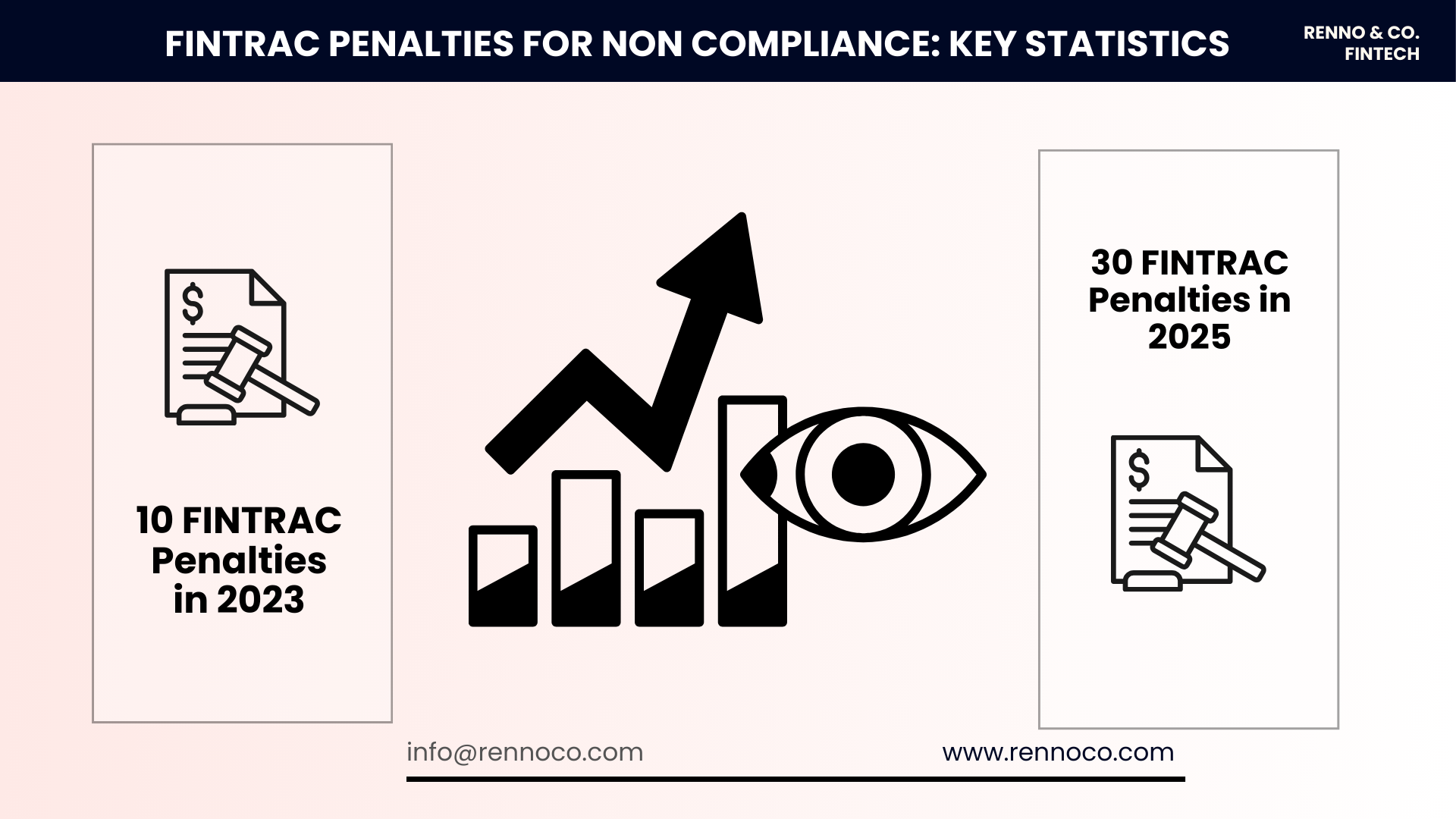
2025 was one of the most active enforcement periods in recent FINTRAC history. The agency increased oversight for MSBs, real estate brokerages, and PSPs. This led to the discovery of multiple violations for which FINTRAC imposed a total of 30 penalties.
Here are the key things to remember from 2025 FINTRAC penalties for non compliance:
- A record-breaking penalty of $176,960,190 was imposed on a British Columbia-incorporated MSB for over 2,593 contraventions
- A foreign MSB operating in Canada received a penalty of $19,552,000 for three violations
The increased number of penalties in 2025 shows that FINTRAC's security measures have improved significantly. Active scrutiny will continue in the following years to cut down cases of non compliance.
12 FINTRAC Penalties Issued in 2024
In 2024, FINTRAC issued 12 penalties during its fiscal year (April to March), reinforcing a steady increase in administrative monetary enforcement. Some noteworthy developments from 2024 include:
- A major Canadian bank was fined over $9 million for administrative violations under the PCMLTFA
- A global crypto platform was fined over $6 million
- Multiple real estate brokerages and MSBs were fined between $33,000 and $315,000
While lower than the previous years, these penalties clarify that even without criminal offences, non compliance can lead to significant fines.
What to Learn From Past FINTRAC Penalties
The increasing number of FINTRAC penalties in recent years shows that enforcement is being taken more seriously. AMPs are being applied to different sectors, such as real estate, money services, and more.
Enterprises and foreign MSBs are also not exempt from FINTRAC penalties. The key lesson to learn from these statistics is that non compliance will lead to serious operational consequences. Reporting entities must invest in ongoing compliance and continuous monitoring to protect themselves.
Seeking help from a fintech lawyer may also assist MSBs in navigating AML regulations to avoid penalties.
FAQs
What are FINTRAC Penalties for Non Compliance?
FINTRAC penalties may be administrative monetary penalties or criminal consequences, such as a summary conviction. These punishments are imposed when reporting entities fail to meet AML compliance obligations under Canadian law.
How High can FINTRAC Penalties be?
There is no fixed amount for FINTRAC penalties because they depend on the severity of the violation. Significant fines are imposed in some cases, while imprisonment may be imposed for criminal offences leading to non compliance.
What Triggers FINTRAC penalties for non compliance?
FINTRAC penalties may be triggered by different actions, such as failure to report suspicious transactions or large cash transactions. Other triggers include weak AML compliance programs, failure to conduct timely AML effectiveness reviews, and inadequate record-keeping.
Can Fintechs Reduce the Risk of FINTRAC Penalties?
Maintaining a strong compliance framework and conducting regular reviews significantly reduces exposure. Collaborating with a fintech lawyer or AML compliance officer may also help reduce the risk of penalties.
Reduce the Risk of FINTRAC Penalties With Renno & Co. Fintech
The increasing number of FINTRAC penalties shows that Canada's regulatory environment is becoming stricter. Active compliance and continuous monitoring are no longer optional for fintechs in Canada.
Renno & Co. Fintech assists MSBs, PSPs, and crypto businesses in navigating FINTRAC guidance with clarity and precision. Contact us today to enhance fintech compliance and reduce your chances of facing penalties.
Ready to get started?
Talk To UsBook a Free Consultation
Speak with our fintech legal advisor
about your registration


