


Compliance with anti-money laundering regulations under the Proceeds of Crime (Money Laundering) and Terrorist Financing Act (PCMLTFA) is not optional but mandatory. All money service businesses (MSBs), payment service providers (PSPs), and crypto exchanges must adhere to the federal laws.
An AML officer in Canada helps your business comply with AML regulations and ensure you're monitoring/reporting transactions appropriately. If you want to learn more about the role of an AML officer, check out our post below.
What is an AML Officer in Canada?
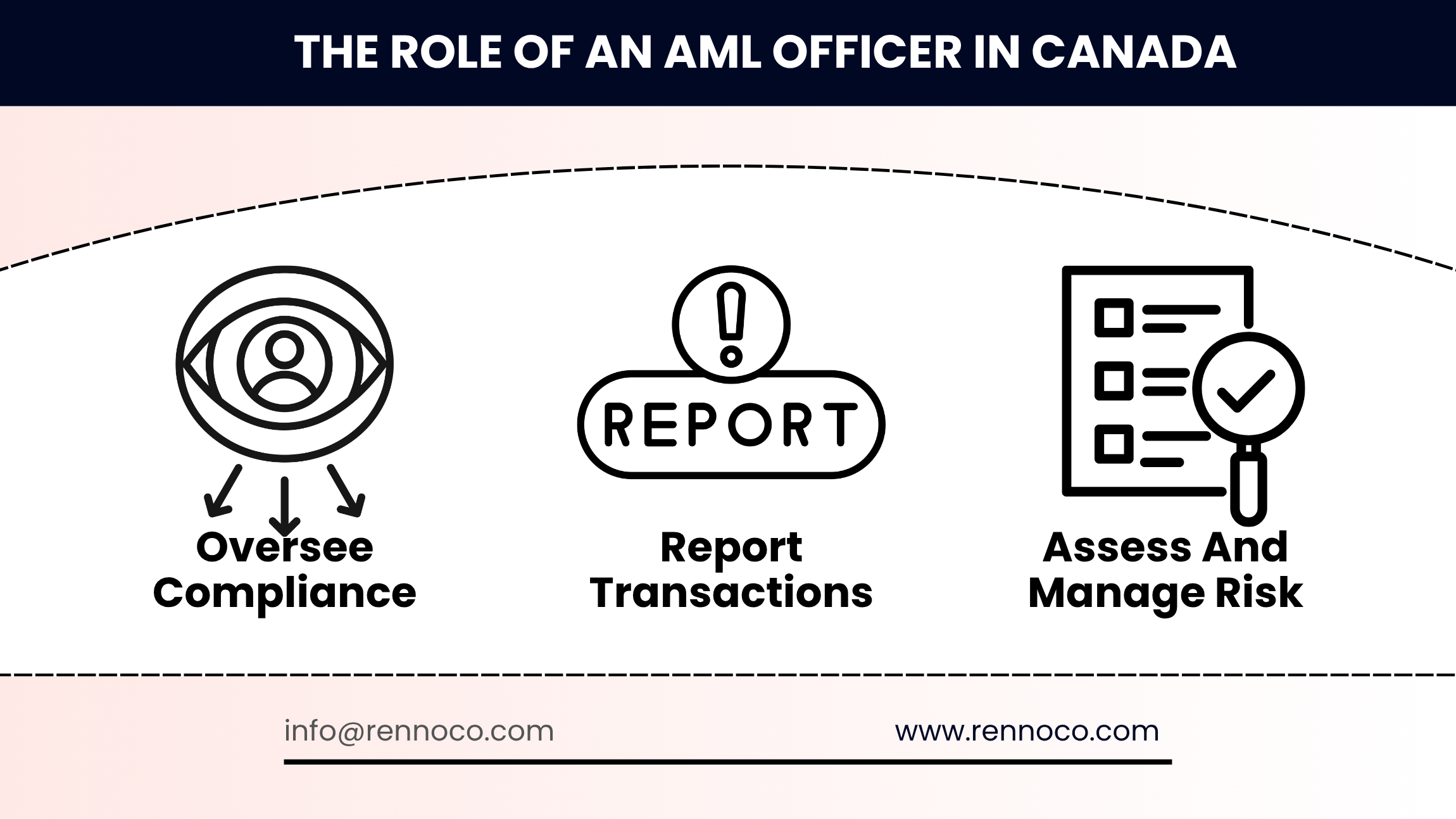
AML officers in Canada are responsible for overseeing compliance under the PCMLTFA and related regulations. Their duties revolve around various aspects of anti-money laundering measures, such as:
- Developing a risk management framework
- Monitoring and reporting suspicious transactions
- Conducting AML effectiveness reviews periodically
- Identifying clients during specific transactions
- Implementing updated AML compliance policies
An AML officer ensures your MSB remains compliant with FINTRAC regulations to help you avoid consequences of non-compliance, such as MSB registration revocation.
What is the Role of an AML Officer in Reporting and Assessing Risk?
The two major duties of an AML officer, besides compliance oversight, include fulfilling reporting obligations and risk management. Let's look at these roles in more detail:
Reporting Obligations
Regulatory reporting is one of the key responsibilities of an AML officer under FINTRAC regulations for MSBs. You must submit timely reports to the regulatory agency to prevent non-compliance consequences. These reports include:
- Suspicious Transaction Reports (STRs) -- must be filed upon reasonable grounds that may indicate potential money laundering or terrorist financing
- Large Cash Transaction Reports (LCTRs) -- must be filed if a client is asking you to perform a transaction involving $10,000 in cash or more
- Electronic Funds Transfer Reports (EFTRs) -- must be filed when you initiate an international electronic funds transfer of $10,000 or more
- Large Virtual Currency Transaction Reports (LVCTRs) -- must be filed if a client is asking you to perform a transaction involving virtual currency equivalent to $10,000 or more in a single transaction
Failure to submit these reports within their deadlines may lead to administrative monetary penalties or other non-compliance measures by FINTRAC against your MSB. An AML officer may prevent such penalties by ensuring your business is compliant with all reporting requirements.
Risk Assessment and Management
A critical role of a Canadian AML officer is conducting ongoing risk assessment. This means the officer must:
- Identify high-risk transactions, clients, and geographic locations to fulfill know-your-customer requirements
- Prepare and continuously update the MSB's risk-based approach to AML as regulations evolve
- Offer advice on risk mitigation and implement effective strategies for risk management
Ongoing risk assessment and management are essential for ensuring adaptability to evolving AML regulations in Canada.
Why is an AML Officer Essential for Fintechs and Crypto Exchanges?
Modern financial institutions such as fintechs and crypto exchanges benefit significantly from the expertise of an AML officer. This is because online transactions and payment methods are more susceptible to financial crimes such as money laundering. A Canadian AML officer protects MSBs, PSPs, and crypto exchanges by:
- Preventing regulatory violations that may lead to monetary penalties, reputational damage, revocation of MSB registration, and other non-compliance consequences
- Reviewing internal payment processing services, crypto trading platforms, and cross-border financial transactions to ensure they comply with AML regulations
- Enhancing customer due diligence through effective screening of sanctioned clients and identity verification of high-risk/suspicious clients
For fintechs and crypto exchanges, the measures taken by AML officers in Canada are vital to save companies from being misused for illegal activities. Your compliance officer may also serve as the first point of contact during FINTRAC audits to represent and defend your business.
How do AML Officers at Renno & Co. Fintech Support Business Growth?
AML officers in Canada may be associated with regulatory enforcement, but they do more than that. At Renno & Co. Fintech, our compliance officers support business growth for PSPs, MSBs, and crypto exchanges in various ways:
Investor Confidence
Our AML officer helps your business thrive by promoting investor confidence through effective compliance. Active MSB, RPAA, and other regulatory registrations without a violation history allow banking partners to mark reporting entities as green flags and increase the chances of building banking partnerships.
Market Access
AML officers at Renno & Co. Fintech can assist you with obtaining provincial MSB registration, such as Revenu Quebec registration and federal FINTRAC MSB registration for local or foreign MSBs. This allows you to operate legally across different provinces and countries, enhancing market access.
Operational Efficiency
We streamline your MSB's anti-money laundering processes by promoting the use of automated systems and reducing manual checks. These measures improve transaction processing and offer clients the confidence they require when sending or receiving funds.
FAQs
Is an AML Officer Mandatory for all Canadian Fintechs?
Yes, all reporting entities, including fintechs, are required to appoint a compliance officer under the PCMLTFA. The reporting entities include MSBs, PSPs, crypto exchanges, and other financial service providers.
Is a Single AML Officer Enough for Managing Multiple Business Units?
Yes, a single AML officer can be adequate for managing multiple business units as long as they have proper qualifications, sufficient authority, and resources. The officer must be capable enough to maintain effective monitoring, record-keeping, and reporting systems to fulfill FINTRAC compliance obligations.
What will happen if my MSB fails to appoint an AML Officer in Canada?
FINTRAC may impose administrative monetary penalties, operational restrictions, and audit against non-compliant MSBs. The agency may also revoke your MSB registration for failing to meet AML requirements under the PCMLTFA.
How Does an AML Officer Interact With FINTRAC?
AML officers serve as the primary point of contact for FINTRAC during audits, submission of transaction reports, and inquiries involving suspicious clients. Hiring an experienced AML officer ensures your company is adequately represented during unforeseen compliance situations.
Partner With an Experienced AML Officer in Canada at Renno & Co. Fintech to Navigate Regulatory Landscape
An AML officer in Canada is critical for MSBs, PSPs, and crypto exchanges due to the complex regulatory landscape of the country. Such officers ensure your business operates within Canadian AML regulations and mitigate the risk of unintentionally facilitating financial crimes.
Renno & Co. Fintech can support your compliance journey by outsourcing professional AML officers to fulfill FINTRAC obligations. From developing AML policies to conducting AML effectiveness reviews, we help your business stay compliant in an ever-changing regulatory landscape. Contact us today to speak to our AML specialist and safeguard your business.
Ready to get started?
Talk To UsBook a Free Consultation
Speak with our fintech legal advisor
about your registration


