


The Markets in Crypto Assets Regulation (MiCA) has been hailed as a landmark achievement in the European Union's effort to bring order and oversight to the rapidly evolving crypto industry. It promises a unified regulatory framework for all 30 EEA member states. But with the introduction of MiCA also comes the question of whether it will make or break the crypto market. Let's learn more about it today.
What is MiCA Compliance?
MiCA is the EU's first dedicated crypto-asset regulation and forms part of the broader EU Digital Finance Package, alongside DORA and the DLT Pilot Regime. MiCA was formally adopted on April 20, 2023, with ART and EMT rules taking effect June 30, 2024, and the full CASP framework applying from December 30, 2024.
The implementation of the Markets in Crypto Assets Regulation will continue till 2026. After that, businesses must engage in continuous MiCA compliance and license renewals for smooth operations.
MiCA Regulation: What Does it Regulate?
MiCA regulation involves crypto assets such as:
- Asset-referenced tokens (ARTs)
- E-money tokens (EMTs)
- Crypto-asset service providers (exchanges, custodians, wallet providers, etc.)
- Other crypto-assets (utility tokens, Bitcoin, Ether)
While ARTs and EMTs are types of stablecoins, MiCA doesn't use this term.
MiCA Regulation: What Does it not Regulate?
Digital asset business owners believe MiCA regulation covers all crypto assets. That's not true. The Markets in Crypto Assets Regulation doesn't cover:
- Non-fungible tokens (NFTs), unless they function as financial instruments
- Decentralized protocols without identifiable operators (though this may change in future regulation)
- Crypto-assets that are already regulated as securities under MiFID II
Keep in mind, NFTs are excluded only when they are genuinely unique and non-fungible. Fractionalized NFTs or large identical series may still fall within MiCA's scope.
What is the Aim of MiCA Compliance?
MiCA has been designed to ease the licensing processes for crypto asset providers. It also aims to:
- Protect consumers
- Ensure financial stability
- Prevent money laundering and terrorist financing
- Promote innovation through legal clarity
The debate around MiCA regulation begins when business owners try to understand how the authorities will achieve these aims.
The Benefits of MiCA Regulation: Bringing Order to Chaos
Getting a MiCA license and following its compliance rules offer benefits such as:
A Unified Regulatory Framework
Before the introduction of MiCA, crypto asset providers in Europe had to get multiple licenses. The type of license they used to require depended on the jurisdiction of operation.
MiCA regulation eradicates the need for multiple licenses by creating a unified framework. Regardless of your target area, the Markets in Crypto Assets Regulation license will allow you to offer your services to residents of all 30 members of the EEA (27 EU members and 3 EFTA members).
Consumer Protection
Crypto assets are highly volatile and affect financial markets significantly. This uncertain nature of cryptocurrency has been further established by the collapse of FTX in November 2022. The EU's MiCA regulation aims to protect consumers from the volatile nature of cryptocurrency by:
- Requiring transparent whitepapers for token issuers
- Requiring clear disclosures on risks from crypto asset providers
- Enhanced custody protections
These measures are likely to increase trust in the ecosystem and reduce fraud, especially among retail users.
Regulatory Certainty
Legal challenges of licensing for crypto business owners have always hurt the service providers. However, these challenges will no longer be significant because of the clarity provided by MiCA regulation.
The exact timeline of MiCA compliance allows startups, exchanges, and investors to plan long-term strategies without fear of sudden crackdowns.
The Risks: Could MiCA Compliance Over-Regulate the Market?
Despite its promise, MiCA comes with significant downsides that have sparked concern among startups, DeFi builders, and privacy advocates.
High Entry Costs
Becoming a licensed crypto asset service provider (CASP) under MiCA is no small feat. Requirements include:
- One office in an EU country
- One director who is a resident of an EU country
- Implementation of comprehensive anti-money laundering (AML) policies
- Fulfillment of KYC obligations and practices to handle consumer complaints
- Implementation of data security policies
Compliance setup costs can reach into the hundreds of thousands for larger firms, though most CASPs can expect authorization to take approximately three to six months.
Barriers for Small or DeFi Operators
MiCA has been designed with centralized service providers in mind. For decentralized finance (DeFi) protocols with no centralized operator, this creates a regulatory grey zone. Some fear that:
- DeFi teams will be forced to incorporate and register as CASPs
- Anonymous contributors may face legal risk
- Protocol development could move offshore
Operational Delays and Bottlenecks
Regulatory approval processes are likely to become overwhelmed as CASPs scramble to apply. Without sufficient staffing and standardized processes, regulators may struggle to keep up, delaying launches and undermining innovation.
How Canadian Crypto Firms are Reacting to MiCA Compliance Rules
MiCA regulation has international implications regardless of where your business is based. If you remotely offer any service to EU residents or in an EU country, you need to get a license and maintain MiCA compliance.
Canadian FINTRAC MSB registration has been mandatory since its enforcement in 2008. The registration allows fintech companies to enroll as a local or foreign money service business.
You must create a compliance program, an AML policy structure, and appoint a compliance officer for Canadian fintech registration. The FINTRAC MSB registration permits firms to operate within or direct services in Canada, but does not confer operating authority in other jurisdictions.
Crypto service providers can launch and test their product in different markets. The licensing process is also allowing crypto asset providers to delay EU expansion until MiCA compliance clarity improves.
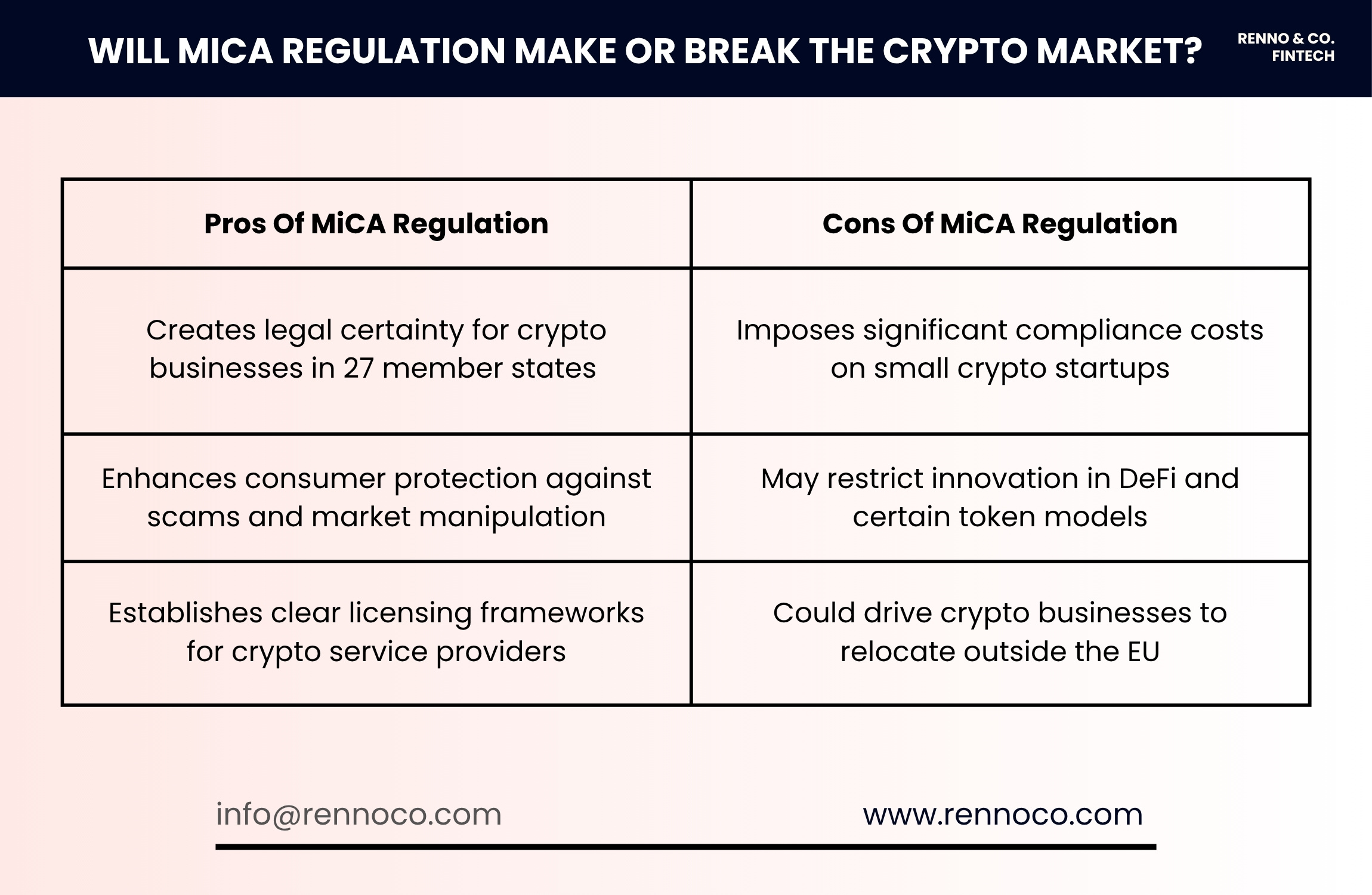
Will MiCA Regulation Ultimately Help or Hurt the European Crypto Market?
MiCA regulation can do both: help and hurt the European crypto market. The exact outcome depends on the type of crypto asset business you own and the services you want to offer.
You can enjoy greater clarity under the Markets in Crypto Assets Regulation. By the implementation of uniform rules, MiCA compliance makes market consolidation easier, and regulatory oversight significantly enhances consumer protection.
However, MiCA regulation can hurt the European market by pushing out small players. Implementation of compliance programs and appointment of directors may be too expensive for startups. Innovation may suffer because business owners don't want to take the risk of experimenting with new products.
So the real question is the type of future the EU wants for the crypto market. If it's a safer but less innovative financial system, then MiCA regulation will be beneficial.
MiCA Compliance: Enter the Market Fully-Informed With a Fintech Lawyer
MiCA compliance may seem like an easy task, but getting approval for the license is tricky. Any error in your application or compliance program can lead to rejection. You can avoid these issues by seeking support from a fintech law firm such as Renno Co. & Fintech.
Our firm specializes in developing AML policies, outsourcing compliance officers, and getting you banked. We also help you understand the Markets in Crypto Assets Regulation. If you're navigating global crypto compliance, let's talk.
Ready to get started?
Talk To UsBook a Free Consultation
Speak with our fintech legal advisor
about your registration


