


Our mission is to help Canadian fintech companies get registered, go live, and stay compliant.
The current MSB registration timeline in Canada is not “a few weeks.” As of September 2026, Renno & Co. typically sees FINTRAC registration take about five to six months on files we manage. Applicants filing without experienced support may wait nine months or longer. A fresh RPAA registration with the Bank of Canada is currently moving faster, at roughly two months in many recent files. These are practical estimates, not guaranteed service standards.
The main planning mistake is treating submission as the finish line. Your real timeline includes deciding which registrations apply, preparing the application materials, waiting for regulator review, and most importantly — getting banked! If your model needs both registrations, start them together. Do not wait until the product is finished and a launch date is already fixed.
How long does FINTRAC MSB registration take?
A realistic planning estimate is about five to six months for an MSB registration managed with Renno. Market feedback suggests some businesses applying without experienced support may wait nine months or longer. FINTRAC does not promise that every application will fit those ranges, so founders should treat them as planning estimates and leave room for questions, corrections, and operational dependencies.
A money services business (MSB) is a business that provides covered services such as foreign exchange, funds transmission, cheque cashing, or virtual-currency dealing. FINTRAC is Canada’s anti-money-laundering regulator. Its official MSB guidance explains which Canadian and foreign businesses must register.
It is also important to use the right word. FINTRAC provides registration, not a general business “licence.” Registration does not mean the regulator endorses the company, guarantees its business model, or confirms that every product feature complies with every Canadian law.
Filing time and regulator review time are different
The filing date is only the point when the application enters the regulator’s process. Before that, the team must determine whether the business is a Canadian MSB or foreign MSB, map the services and jurisdictions, prepare the compliance program, collect ownership and management information, and make sure the application matches the product. Regulator review begins after submission and remains outside the applicant’s direct control.
That distinction matters when a provider promises to “get the licence in a few weeks.” The provider may be describing the time needed to prepare and submit forms, not the time needed to become registered. A fast filing can still sit in review for months.
To learn more about how we can help with your MSB registration, see here.
How long does Bank of Canada RPAA registration take?
Fresh RPAA registration is currently taking roughly two months in many recent files, but the timeline is uneven and is not guaranteed. Some earlier applicants have remained in the queue much longer while newer applications have moved more quickly. The practical lesson is to use the current two-month experience for planning without assuming every application will be reviewed in the order or timeframe you expect.
The Retail Payment Activities Act (RPAA) requires many payment service providers (PSPs) to register with the Bank of Canada before performing covered retail payment activities. The Bank’s registration criteria focus on whether the business is a PSP, performs payment functions connected to electronic funds transfers, falls within the Canadian geographic scope, and is not excluded.
The current RPAA approval timeline is meaningfully shorter than the early market expected. That does not make RPAA registration an administrative formality. The application still needs to accurately describe the payment functions, end-user relationships, flow of funds, operational risks, and safeguarding arrangements where the business holds end-user funds.
To learn more about how we can help with your RPAA registration, see here.
Why is my MSB registration taking so long?
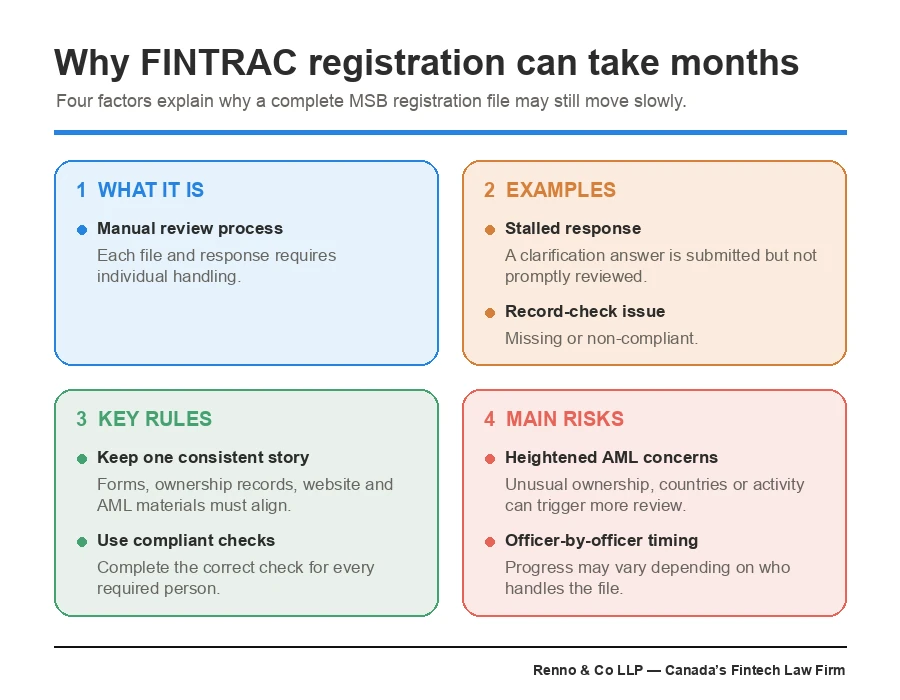
MSB registration takes so long largely because FINTRAC’s registration process remains heavily manual. Applications do not move through a simple automated queue with predictable service standards. A person must review the file, decide whether clarification is needed, send questions, assess the response, and move the application forward. That creates delay, inconsistency, and long periods where an otherwise complete application may appear to be sitting still.
Because the process is manual, the speed of an application can depend significantly on the FINTRAC registration officer assigned to the file. In Renno’s experience, some officers review applications and respond to follow-ups relatively quickly, while others take much longer between steps. Two similar applications submitted at similar times can therefore move at very different speeds, even where neither applicant has done anything wrong.
Manual file handling also creates a practical risk that applications, responses, or follow-up steps slip through the cracks. A clarification response may be submitted but not promptly reviewed. A file may remain inactive after the applicant has provided everything requested. An applicant may receive no substantive update for months, even though the application has not been refused and no additional information is outstanding.
This does not mean every delay is FINTRAC’s fault. Incomplete ownership information, an unclear business model, conflicting documents, or slow responses to clarification requests can still extend the process. But once a complete file is in review, the regulator’s manual workflow and the practices of the assigned officer can become the main timing variable.
How does Renno speed up the registration timeline?
Renno can often move a stalled registration file forward by escalating it through established personal relationships we have with managers in the registration units at both FINTRAC and the Bank of Canada. Because these processes involve manual review, files regularly stop moving even after the applicant has provided everything requested. A timely escalation can bring the file back to the regulator’s attention and prompt the next review step.
We’ve seen some real horror stories where someone tries to get MSB registered themselves and they have not heard back from FINTRAC 12+ months after they’ve submitted their initial registration request. Having relationships with the right folks really helps here!
This does not guarantee approval or a fixed completion date. It means Renno can identify when a delay appears unreasonable, confirm what remains outstanding, and raise the matter with the appropriate people instead of relying only on general inboxes. If your MSB or RPAA application has stalled, book a call to discuss the available follow-up and escalation options.
Can I start MSB and RPAA registration at the same time?
Yes. A company does not need to finish FINTRAC registration before starting its Bank of Canada application. If the product requires both MSB and RPAA registration, the applications can usually be prepared and submitted in parallel. With current timing, FINTRAC registration will take longer than RPAA registration. Either way, you want to start both at once to reduce delay as much as possible.
The two applications regulate different issues and should not be treated as duplicates:
| Workstream | FINTRAC MSB registration | Bank of Canada RPAA registration |
|---|---|---|
| Main focus | FINTRACAnti-money laundering and terrorist financing | Bank of CanadaOperational risk and safeguarding end-user funds |
| Current practical timing | FINTRACAbout 5–6 months with Renno; potentially longer for some solo applicants | Bank of CanadaRoughly 2 months for many fresh applications |
| Can it run in parallel? | FINTRACYes | Bank of CanadaYes |
The applications still need to tell a consistent story. The legal entities, services, jurisdictions, customer relationships, and flow of funds described to one regulator should not conflict with what is described to the other. Renno’s combined MSB registration and RPAA registration work is designed to coordinate those tracks, including the AML policy and operational risk management framework.
What slows the registration process down?
FINTRAC and Bank of Canada registrations slow down for different reasons. FINTRAC delays often come from its manual systems, deficient criminal record checks, internal inconsistencies, or concerns about money-laundering risk. Bank of Canada delays are more likely when the business raises risk or national-security concerns, or when its safeguarding arrangements do not clearly satisfy the RPAA requirements.
What causes FINTRAC registration delays?
FINTRAC’s process is heavily manual, so a complete file can stall after submission or after the applicant answers a clarification request. The file can also slow down when the application contains inconsistent information, required criminal record checks are missing or non-compliant, or the business model, ownership, customers, countries, or expected transactions raise heightened anti-money-laundering concerns.
The main causes are:
- Manual processing. Applications and responses require individual handling. Files can sit without movement, and timing may depend on the registration officer assigned to the application.
- Criminal record check problems. A required criminal record check may be missing, out of date, completed for the wrong person, or prepared in a form that does not meet FINTRAC’s requirements.
- Internal inconsistencies. The registration form, corporate records, ownership information, website, business plan, AML documents, and flow of funds may describe different activities or facts.
- Heightened AML risk. FINTRAC may ask more questions where the proposed services, ownership, customers, jurisdictions, transaction patterns, or other facts appear unusual or present elevated money-laundering or terrorist-financing risk.
What causes Bank of Canada registration delays?
Bank of Canada review can take longer where the applicant’s business activities, ownership, counterparties, jurisdictions, or payment flows raise serious risk concerns. Certain concerns may trigger a national-security review involving the Department of Finance. Delays can also arise where the applicant holds end-user funds but has not clearly explained or established a compliant safeguarding structure.
The main causes are:
- High-risk or suspicious business activity. The Bank may require further information to understand the applicant’s ownership, business model, counterparties, geographic exposure, or payment activity.
- National-security review. Where the relevant concerns are present, the application may be referred for a separate national-security review involving the Department of Finance, adding another review process and extending the timeline.
- Safeguarding issues. If the applicant holds end-user funds, unclear account structures, inadequate agreements, or uncertainty about how funds will be protected can lead to further questions and delay.
A delayed file should be diagnosed based on the regulator and the actual issue. A stalled manual FINTRAC file, a deficient criminal record check, an AML-risk concern, a national-security review, and an unresolved safeguarding structure each require a different response.
Should I build the product first and register later?
Usually not. You do not need a fully finished product before starting legal analysis, but the product must be developed enough to explain what the business will do and how money moves. The best approach is to run product design, regulatory analysis, application preparation, banking, and compliance implementation as connected workstreams rather than finishing one and starting the next.
Waiting until the product is complete creates two risks. First, registration time becomes dead time because the launch-ready product cannot legally go live. Second, the legal review may identify a feature that needs to be redesigned, such as holding funds at rest, controlling payment instructions, or custodying crypto. Fixing that issue after development is usually slower and more expensive than addressing it during design.
A practical sequence is:
- Map the product, parties, jurisdictions, and flow of funds.
- Decide whether MSB registration, RPAA registration, or both apply.
- Start the required applications and supporting compliance documents.
- Build the product and operations against the approved regulatory structure.
- Complete banking, vendor onboarding, testing, and launch readiness while the applications are reviewed.
Frequently asked questions
Does FINTRAC guarantee a five-to-six-month timeline?
No. Five to six months is Renno’s current practical experience on many managed files as of August 2026, not a published FINTRAC guarantee. A specific application may move faster or slower depending on the regulator’s queue, the business model, the completeness of the filing, and whether facts change during review. Build contingency time into the launch plan instead of treating the estimate as a deadline.
Does the Bank of Canada guarantee RPAA approval in two months?
No. Roughly two months reflects recent experience with many fresh applications, not a guaranteed Bank of Canada service standard. Earlier applicants may still face much longer waits, and individual files can take more time. Use the current estimate to sequence work, but do not promise investors, partners, employees, or customers that approval will arrive on a fixed date.
Can I operate while my application is pending?
Do not assume that filing alone authorizes a new business to operate. FINTRAC and the Bank of Canada have separate rules, and limited transitional treatment for some earlier RPAA applicants does not create a general permission for new applicants. Before launching, confirm which registrations apply, whether they are effective, and whether the product has any other legal or operational blockers.
Set the registration plan before setting the launch date
The safest planning assumption is that FINTRAC MSB registration may be the longer regulatory track, while a fresh RPAA application may move faster but remains unpredictable. Start both together where both apply, keep product and application materials aligned, and run banking and compliance setup in parallel. If you are planning a Canadian launch, book a call before committing to a public go-live date.
Disclaimer: This content is for informational purposes only and does not constitute legal advice.
Ready to get started?
Talk To UsBook a Free Consultation
Speak with our fintech legal advisor
about your registration


