


Our mission is to help Canadian fintech companies get registered, go live, and stay compliant.
Running a money services business (MSB) or payment service provider (PSP) in Canada carries ongoing costs, not just one-time setup fees. The good news: FINTRAC, Canada's anti-money-laundering regulator, charges no government fee to register or stay registered as an MSB. Your real recurring spend comes from compliance software, a mandatory AML review every two years, professional services, and — if you register as a PSP or operate in Québec — annual government fees. What you pay depends on where you operate and what you do.
A quick note on terms. The RPAA (Retail Payment Activities Act) is the law that requires many payment businesses to register as a PSP with the Bank of Canada. Your AML compliance program is the set of policies, controls, and reviews you must keep running once you are registered. Below we break the ongoing costs into government fees, professional services, and software, then flag which ones actually apply to you.
What are the ongoing costs of running an MSB or PSP in Canada?
Ongoing costs fall into three buckets: government fees, professional services, and software. Every MSB should budget for compliance software and a two-year AML review. PSPs registered under the RPAA and MSBs licensed in Québec also pay annual government fees. Crypto businesses add wallet-screening software, and any Canadian corporation pays yearly tax and registry filings. The table below shows the typical items, who they apply to, and rough costs.
| Cost | Who it applies to | How often | Fee type | Approx. cost (CAD / USD) |
|---|---|---|---|---|
| Bank of Canada PSP registration | RPAA-registered PSPs | One time | Government | $2,500 / ~$1,775 |
| Bank of Canada annual PSP fee | RPAA-registered PSPs | Annual | Government | ~$2,500 / ~$1,775 (varies) |
| Revenu Québec MSB licence | Québec MSBs | One time | Government | ~$1,600 / ~$1,100 |
| Revenu Québec annual MSB fee | Québec MSBs | Annual | Government | ~$1,600 / ~$1,100 |
| AML effectiveness review (audit) | All MSBs | Every 2 years | Professional services | $14,950 / $10,950 |
| KYC software | All MSBs | Monthly | Software | ~$700–$1,400 / ~$500–$1,000 |
| Transaction monitoring software | As needed | Monthly | Software | ~$700–$1,400 / ~$500–$1,000 |
| Crypto screening software | Virtual asset businesses | Monthly | Software | ~$700–$1,400 / ~$500–$1,000 |
| Physical presence (address) | All MSBs | Monthly | Varies | Depends on option |
| Fractional AML / compliance officer | As needed | Monthly | Professional services | ~$2,750–$7,000 / ~$2,000–$5,000 |
| Nominee director | As needed | Monthly | Professional services | ~$2,750 / ~$2,000 |
| Corporate tax filing | Canadian corporations | Annual | Professional services | $700–$1,750 / ~$500–$1,250 |
| Annual report filing | Canadian corporations | Annual | Professional services | $350 / $250 |
Do you have to pay FINTRAC a fee to stay registered?
No. FINTRAC does not charge a government fee to register as an MSB or to keep your registration active. That surprises many founders. The cost of being an MSB is not a licence fee — it is the ongoing compliance work FINTRAC expects: keeping your AML compliance program current, monitoring transactions, filing reports, and completing a periodic review. Those obligations, not a registration fee, drive your real spend.
If you are still deciding whether you need to register at all, FINTRAC sets out who must register as an MSB, and its compliance guidance is the starting point for the ongoing obligations that follow. Please see our guide here on whether you may need MSB registration. Getting the Canadian MSB registration right at the outset keeps these ongoing costs predictable.
What government fees apply — and to whom?
Government fees only apply in two situations. If you register as a PSP under the RPAA, you pay the Bank of Canada a one-time registration fee of about $2,500 and a similar annual fee to stay in good standing. If you hold a Québec MSB licence, you pay Revenu Québec roughly $1,600 to apply and about $1,600 each year to renew. If you do neither, you owe no ongoing government fee for your MSB status.
The Bank of Canada publishes the criteria for registering payment service providers, which is the authority to check before you file. The Québec fees only matter if you operate in Québec or serve Québec clients — if you don't, you can ignore them.
How much does the AML effectiveness review cost?
Every Canadian MSB must complete an effectiveness review — an independent audit of your compliance program — at least once every two years. Renno charges $14,950 (about $10,950 USD) for this review. It is one of the largest recurring line items, but it is not optional: FINTRAC treats a missing or stale review as a compliance failure. Budget for it on a two-year cycle measured from your registration date.
This is a specialist exercise, not a box-ticking task. You can see how we scope and run one on our AML effectiveness review page. Planning for it early — rather than scrambling in year two — is the difference between a clean review and a stressful one.
What compliance software should you budget for?
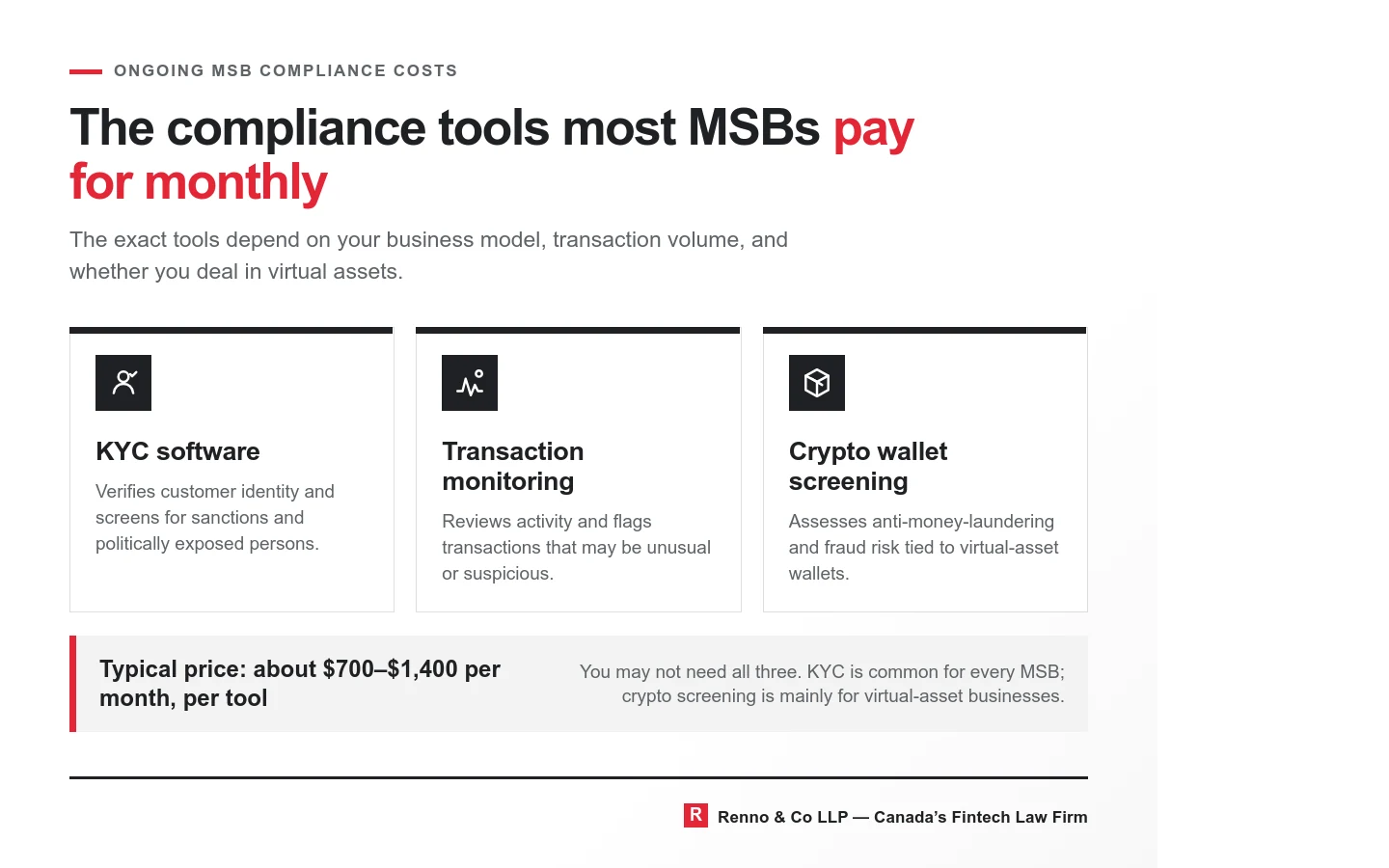
Most MSBs need software to run day-to-day compliance. Expect three common tools: KYC software (know-your-customer) for ID verification and sanctions/PEP screening; transaction monitoring software to flag suspicious activity; and, for crypto businesses, wallet-screening software. Each typically runs about $700–$1,400 per month. You may not need all three, but KYC is effectively required for every MSB.
Popular AML tools we've had good experiences with include SumSub, Persona (what Renno uses to KYC clients), and ComplyAdvantage. Good crypto wallet screening tools include Chainalysis and Nominis.
Whether you need transaction monitoring and crypto screening depends on your volume and whether you deal in virtual assets. A virtual asset service provider (a business offering crypto trading, exchange, or payment services) will almost always need wallet-screening software to assess AML and fraud risk. Lower-volume MSBs sometimes start with manual monitoring, then add software as they scale.
What ongoing obligations and costs apply to PSPs under the RPAA?
If you register as a PSP under the RPAA, your obligations go beyond fees. The Bank of Canada expects you to maintain an operational risk management framework and to safeguard end-user funds, and to report on both. Financially, budget the one-time registration fee (about $2,500) and a similar annual fee. Because MSB and RPAA obligations often overlap, many payment businesses register for both at once.
Setting up both regimes separately is slower and more expensive than doing them together. Renno offers a bundled MSB registration and RPAA registration package that also includes preparing the AML policy required for MSB registration and the operational risk management framework required under the RPAA — so both regimes are covered in one engagement.
What about Canadian presence and banking?
Two practical realities add cost. First, FINTRAC generally expects an MSB to have a Canadian physical presence, and most banks and payment providers expect both a Canadian presence and a working AML program before they will open an account. Second, banking is often the hardest part of going live. Getting registered is only half the battle — you need banking or payment rails in place before you can operate.
For physical presence, MSBs generally have four options: use your own foreign office address, use Renno's address through our back-end AML services, use fully outsourced (fractional) AML services that include an address, or lease your own private office in Canada. The monthly cost depends on which option you choose.
Banking is where many launches stall. Account providers commonly restrict cross-border payments, crypto flows, certain jurisdictions and industries, and operations like cash handling — so lining up the right partner takes time and planning. We maintain a network of banks and account providers and can help you get banked; see our account opening page. If you are weighing how to establish Canadian presence or get banked for your specific model, book a call and we'll map the realistic options before you commit.
What costs are NOT included here?
This overview covers costs tied specifically to being an MSB or PSP and to keeping a Canadian corporation alive. It does not include the everyday costs of running a business: salaries for compliance staff, subscription fees for a customer-facing platform (GUI) if you don't build one in-house, or general expenses like insurance, human resources, accounting, and sales. Factor those into your own budget separately.
It also excludes anything driven by your specific model or volume. A high-volume crypto exchange will spend far more on monitoring and screening than a small foreign-exchange dealer. Use the table above as a floor for planning, not a ceiling.
Frequently asked questions
Does FINTRAC charge a fee to register or stay registered as an MSB?
No. There is no government fee payable to FINTRAC for MSB registration or renewal. Your ongoing costs come from compliance software, professional services, and the effectiveness review — not a licence fee.
How often do I need an AML effectiveness review?
At least once every two years. It is a mandatory independent audit of your AML compliance program, and FINTRAC treats a missing or outdated review as a compliance failure.
What ongoing fees apply if I register as a PSP under the RPAA?
Expect a one-time Bank of Canada registration fee of about $2,500 and a similar annual fee to stay in good standing, plus the ongoing obligation to maintain an operational risk management framework and safeguard end-user funds.
Do I pay extra if I operate in Québec?
Yes. A Québec MSB licence costs roughly $1,600 to apply for and about $1,600 each year to renew, paid to Revenu Québec. This only applies if you operate in Québec or serve Québec clients.
Plan your ongoing costs before you file
Your ongoing MSB and PSP costs are predictable once you know which regimes apply to you — but the wrong structure, a missed effectiveness review, or a stalled banking application can turn a manageable budget into a scramble. If you are mapping out what it will cost to stay registered and operating in Canada, book a call — or fill out our form and we'll get in touch — and we'll walk through the numbers for your model, from registration through banking and your two-year review cycle.
Disclaimer: This content is for informational purposes only and does not constitute legal advice.
Ready to get started?
Talk To UsBook a Free Consultation
Speak with our fintech legal advisor
about your registration


