


Registering your money service business (MSB) in Canada may seem simple, but even the smallest error can lead to severe consequences, such as clarification requests by the Financial Transactions and Reports Analysis Centre of Canada (FINTRAC) or denial of registration. An easy way to avoid such errors is by creating an MSB registration checklist.
Understanding MSB registration requirements and knowing what documents are needed can help you create a comprehensive checklist. Dive into our article below to learn more about money service business registration in Canada.
What is FINTRAC MSB Registration?
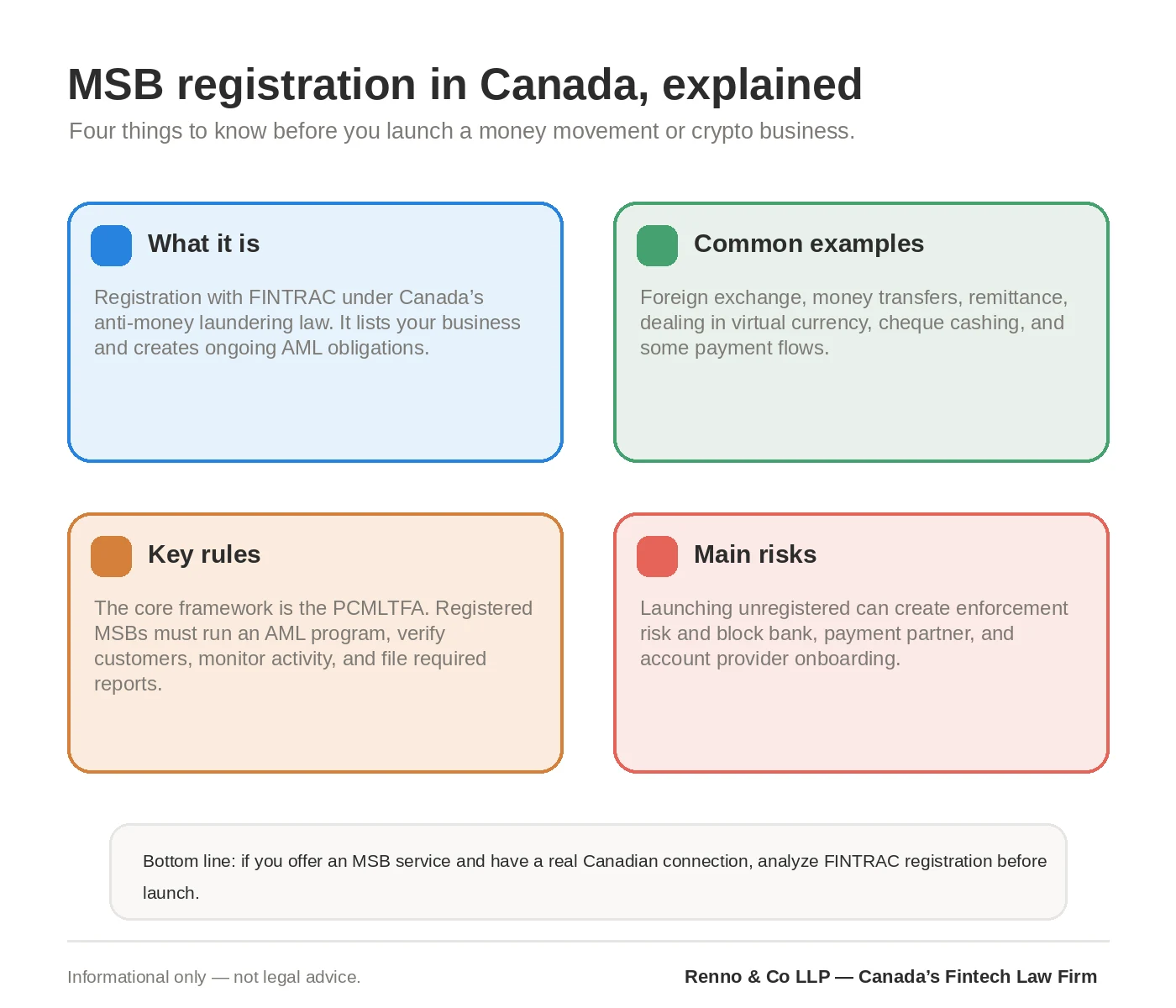
Canadian MSB registration is the official process of registering your business with the federal regulatory agency called FINTRAC. All money service businesses, including foreign MSBs (fMSBs), must fulfill registration requirements and comply with FINTRAC regulations. Examples of such businesses include:
- Foreign exchange dealers (businesses that conduct transactions to exchange one currency for another)
- Businesses that remit or transmit funds
- Virtual currency dealers
- Cheque cashers
- Crowdfunding platform services
If your business is offering any of these services to Canadian or foreign clients, MSB registration requirements will apply to you. Fulfilling these requirements is essential for operating your business legally.
MSB registration is the process of listing your business with FINTRAC under Canada's anti-money laundering law, the Proceeds of Crime (Money Laundering) and Terrorist Financing Act (PCMLTFA). Once registered, your business appears on FINTRAC's public registry and must follow ongoing anti-money laundering rules. Registration confirms you are listed and regulated — it does not mean FINTRAC has approved, endorsed, or vetted your business model.
This matters for two practical reasons. First, operating without registration is not legal for money services business activities. Second, banks and other account providers treat a valid FINTRAC registration as the bare minimum before they will even consider onboarding you, so registration is what makes your business real and bankable in Canada.
Who Needs to Register with FINTRAC?
You need to register if you offer at least one money services business service and you have a place of business in Canada. You also need to register if you are based abroad but direct your services at people in Canada and serve Canadian clients. In short: an MSB activity plus a real Canadian connection triggers registration with FINTRAC.
The two-part test for a Canadian MSB
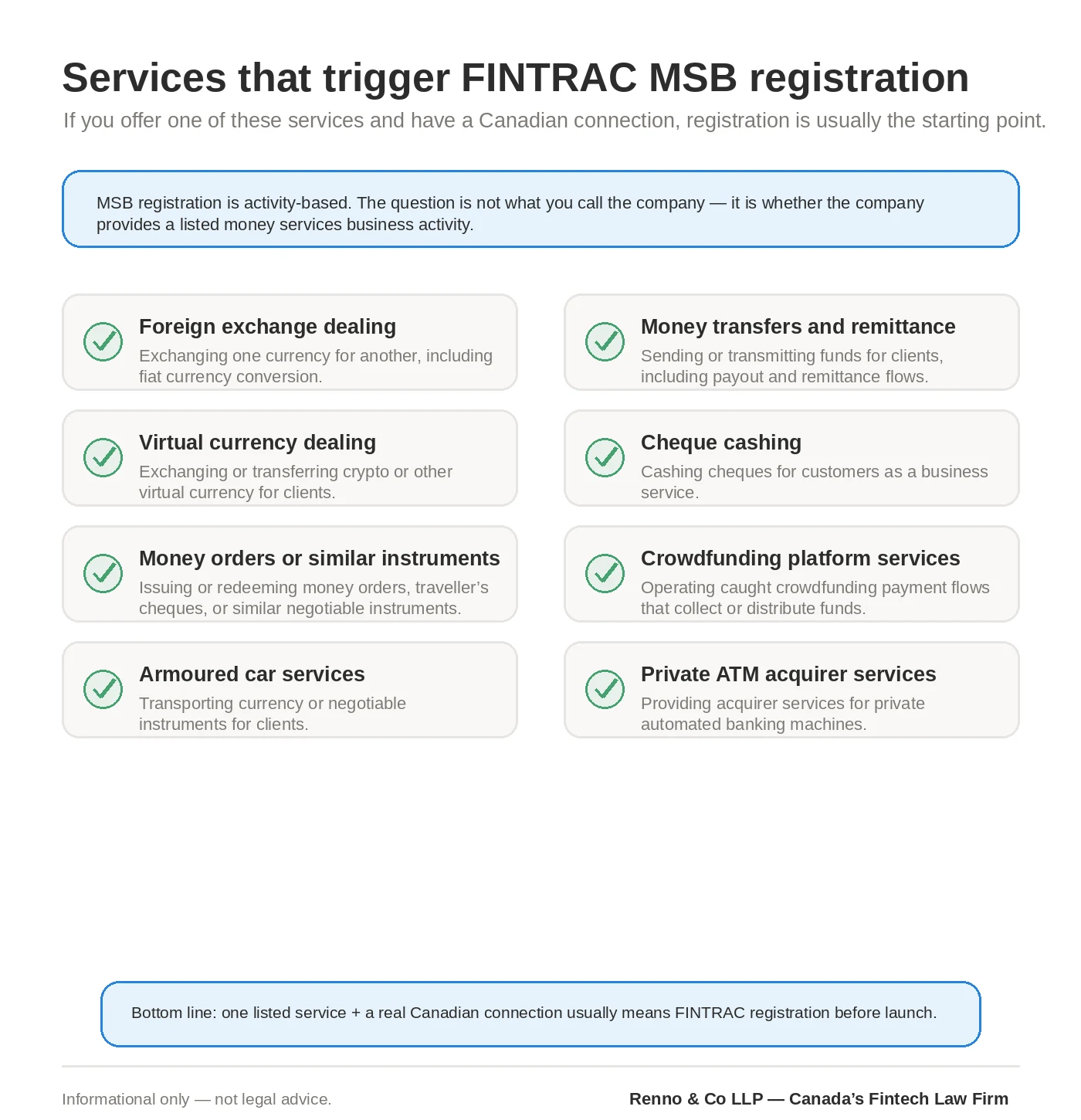
You are a money services business if both parts are true. Part one is that you offer at least one of these services:
- Foreign exchange dealing (exchanging one currency for another)
- Remitting or transmitting funds (money transfers and remittance)
- Issuing or redeeming money orders, traveller's cheques, or similar instruments
- Dealing in virtual currency (both exchanging and transferring crypto)
- Cheque cashing
- Crowdfunding platform services
- Transporting currency or negotiable instruments (armoured car services)
- Acquirer services for private automated banking machines
Part two is that you have a place of business in Canada. Under FINTRAC's test, that means you are incorporated in Canada, have a physical location in Canada, or have employees, agents, or branches in Canada.
What if my business has 0 connection to Canada (and is not incorporated in Canada)?
You can still be caught as a foreign money services business (FMSB). This applies when you have no place of business in Canada but you direct your services at people in Canada and provide services to Canadian clients. FINTRAC treats you as “directing services at Canada” if your marketing targets Canada, you operate a “.ca” domain, or you are listed in a Canadian business directory.
There is one narrow relief here called reverse solicitation. If you are not actively marketing to Canadians, you may avoid a Canadian connection even if you occasionally serve a Canadian client. Be careful with this: reverse solicitation only helps for MSB purposes. It does not apply to RPAA registration or securities registration.
Does a Crypto, FX, or Remittance Business Need MSB Registration?
Yes. Foreign exchange, money transfers and remittance, and dealing in virtual currency are all core MSB activities, so these businesses almost always need MSB registration if they have a Canadian connection. Crypto is captured as “dealing in virtual currency,” which covers both exchanging and transferring virtual currency. Cheque cashing and merchant payment processing are usually caught too.
Many of these businesses also need a second registration. If you help clients send or receive electronic funds, you may also need to register as a payment service provider (PSP) with the Bank of Canada under the Retail Payment Activities Act (RPAA) — a separate law focused on operational risk and protecting customer funds. The table below shows the common models.
| Business model | MSB registration | Often also needs RPAA registration |
|---|---|---|
| Foreign exchange / currency exchange | ✅ | ❌ |
| Money transfer / remittance | ✅ | ✅ |
| Dealing in virtual currency (non-custodial) | ✅ | ❌ |
| Merchant pay-in / payment processing | ✅ | ✅ |
| Payout products | ✅ | ✅ |
| Cheque cashing | ✅ | ❌ |
| Payment processor | ✅ | ✅ |
| Payment service provider | ✅ | ✅ |
One caution: if you hold customer crypto or offer a product that promises returns, you can also trigger provincial securities registration, which is much heavier and slower. If your model has either feature, or if your product is captured by the above checklist, get advice on your RPAA registration and securities exposure early, before you build.
Do I Also Need RPAA Registration?
If you run a remittance, pay-in, or payout product, you likely also need RPAA registration as a PSP with the Bank of Canada. That process is longer — roughly 6 to 12 months — but you can run it in tandem with your MSB application. Note that buying a ready-made RPAA-registered entity is much harder, because the Bank of Canada must approve a change in ownership. You can review the Bank of Canada's criteria for registering payment service providers for more detail. For a side-by-side comparison of the two regimes, see our guide to MSB vs. RPAA registration in Canada.
What are FINTRAC MSB Registration Requirements in Canada?
MSB registration is a relatively lengthy process if you don't know the regulatory requirements or lack essential documents. Let's look at the FINTRAC MSB registration requirements to help you avoid delays in submitting the application:
Appoint a Compliance Officer
FINTRAC requires all Canadian MSBs to appoint a compliance officer before submitting the registration application. This officer will be responsible for overseeing internal compliance measures such as the development of anti-money laundering (AML) policies, employee training, and fulfillment of reporting obligations.
Hiring the officer before MSB registration is essential because you will have to share the officer's name, role, and other details when submitting the registration application. Failure to provide compliance officer information will lead to delays with registration approval, making it a non-negotiable MSB registration requirement.
Develop a Compliance Program
Money service businesses must develop a robust compliance program that details the following things:
- Measures to identify individual clients and entities
- Identification of beneficial owners for corporate clients
- Ongoing monitoring procedures for transactions
- Measures for fulfilling record-keeping requirements and reporting obligations
- Steps of complying with virtual currency rules (if applicable)
- Risk assessment framework and mitigation strategies
- Employee training program information
FINTRAC may require you to attest that your MSB has a comprehensive written compliance program during interviews or audits. The agency may also revoke your registration later if your business is exposed for not having a compliance program.
Renewal and Registration Maintenance
MSB registration is not a one-time thing due to ongoing maintenance requirements. You will have to maintain your registration by renewing it every two years to fulfill FINTRAC MSB registration requirements. All MSBs must fill out the renewal form and send an official request to the regulatory agency.
If you don't renew within the deadline, your MSB registration will expire. This means you'll have to undergo the application process and FINTRAC review again before being able to operate legally in Canada. Note that the MSB registration process is more complex and lengthier than the renewal process.
What Documents are Needed for MSB Registration Canada?
Meeting MSB registration requirements is only one part of registering your business. You must also gather essential FINTRAC registration documents to submit them with the application form. These include:
- Business incorporation certificate (current and valid)
- Documents that set out the ownership, control, and corporate/entity structure
- Partnership agreement, articles of existence, or other records that confirm entity existence if it's not a corporation
- List of all agents and mandataries (if applicable)
- Authorized criminal record checks for chief executives, presidents, directors, and beneficial owners (with 20% or more shares)
These FINTRAC registration documents are essential when registering your business because they demonstrate good standing to the agency. Lack of essential documents can expose your business to application denial or clarification requests, which can lead to operational delays.
Can I Operate Before FINTRAC Registration is Done?
Generally no. You cannot provide money services business services until your FINTRAC registration is complete, which usually takes about 4 to 6 months. Launching first and registering later is not an option for MSB activities. One shortcut exists: buying a ready-made, already-registered MSB, which can let you start in roughly a week because FINTRAC only needs to be notified of a change in ownership, not asked to approve it.
How Long Does MSB Registration Take?
As a planning rule, budget about 5 months to complete MSB registration. Build your go-live date around that timeline rather than assuming you can start once the application is filed. If speed is critical, buying a ready-made MSB is the main way to compress that wait.
For clarity, we have a few key contacts with Managers in FINTRAC's MSB Registration Unit that allows us to escalate MSB registrations that have been in the pipeline for a while (which allows our clients' registrations to get processed faster). We are hearing from market that folks initiate their MSB registration themselves take 9+ months to complete.
What About Banking?
Keep in mind that getting registered is only half the battle! You'll need to get banking / payment rails in place before you can go live. We are connected with a network of banks and account providers and have helped a variety of clients get banked in the past. See here to learn more!
What Happens if You Launch Too Early?
If you operate before you are registered, you are offering regulated services without authorization, which creates real enforcement risk — especially when Canadian users are affected. Just as important, Canadian banks and payment partners will not onboard an unregistered money services business, so you effectively cannot run your flows. Launching early usually blocks you rather than speeds you up.
In practice, your account providers and partners will ask for proof of registration during onboarding and due diligence. Missing registrations are treated as a compliance blocker, not a paperwork detail, and they can stall a launch far longer than the registration itself would have taken.
Ongoing Obligations After You Register
Registration is the starting line, not the finish line. Once registered, you must run an anti-money laundering (AML) compliance program and keep it current. That means identifying your customers, monitoring transactions, reporting certain transactions to FINTRAC, and getting an independent effectiveness review of your program on a regular schedule (often every two years).
At a high level, your ongoing MSB obligations include:
- Identifying and verifying customers (KYC), and keeping that information current
- Monitoring transactions and investigating red flags
- Filing required reports, such as suspicious transaction reports, large cash transaction reports, large virtual currency transaction reports, and electronic funds transfer reports
- Maintaining written AML policies, procedures, and a risk assessment
- Training staff who onboard customers or move money
- Completing an independent effectiveness review of your program on schedule
For the full picture of what applies once you are registered, FINTRAC's guidance for money services businesses is the starting point.
FAQs
How to Register MSB Canada?
You can register your Canadian MSB or fMSB by visiting the FINTRAC website and accessing the pre-registration form. Submit this form and wait for the agency to send you an email with details of the registration form. Complete the form with the relevant information and FINTRAC registration documents. Finally, submit it through the Canada Post Connect message shared by FINTRAC during the registration process.
What is the Cost of MSB Registration?
MSB registration itself doesn't cost anything in Canada because FINTRAC doesn't charge any fees. However, the process may lead to some expenses if you require legal advice or hire a fintech law firm to complete MSB registration on your behalf.
What are the Outcomes of FINTRAC MSB Registration?
There are three outcomes to the FINTRAC MSB registration process in Canada. The agency may approve registration and include your business in the MSB registry. FINTRAC may send a clarification request for some aspects of the application if it is lacking information or missing documents. The final outcome may be the denial of registration with its reason.
What happens if you don't comply with MSB Registration Requirements?
If you don't comply with MSB registration requirements during the application process, your request may be denied. This can lead to operational delays and financial losses, which significantly impact your business.
Let Renno & Co. Fintech Help You Fulfill MSB Registration Requirements
MSB registration requirements may seem difficult to fulfill, but that doesn't have to be the case. Professional assistance can help you draft a thorough compliance program, KYC policies, and AML policies.
Renno & Co. Fintech can also outsource a qualified compliance officer to your business to fulfill MSB registration requirements. Get in touch with us now to get started with your FINTRAC MSB registration process in 2026.
Disclaimer: This content is for informational purposes only and does not constitute legal advice.
Ready to get started?
Talk To UsBook a Free Consultation
Speak with our fintech legal advisor
about your registration


