


Our mission is to help Canadian fintech companies get registered, go live, and stay compliant.
Registering a money services business (MSB) with FINTRAC involves several stages, from determining eligibility and preparing corporate documents to submitting the application and responding to FINTRAC's requests. This guide explains the nine steps to registering an MSB in Canada, the documents you'll need, typical timelines, and what to expect after filing.
Prefer to have an experienced Canadian law firm manage the registration? Explore Renno & Co's FINTRAC MSB registration services.
In this guide
- What Does Registering an MSB With FINTRAC Involve?
- Is FINTRAC MSB Registration the Same as an MSB Licence?
- Who Needs to Register as an MSB With FINTRAC?
- What Information Does FINTRAC Require for MSB Registration?
- Do You Need a Physical Address in Canada for MSB Registration?
- How to Register an MSB With FINTRAC: 9 Steps
- Step 1 — Determine whether you are an MSB or fMSB
- Step 2 — Prepare the company and your registration information
- Step 3 — Prepare your AML compliance program
- Step 4 — Appoint your AML Compliance Officer
- Step 5 — Submit your FINTRAC pre-registration
- Step 6 — Get portal access and FINTRAC's document request
- Step 7 — File your full registration
- Step 8 — Respond to clarification requests
- Step 9 — Registration confirmed
- How Long Does FINTRAC MSB Registration Take?
- How Much Does FINTRAC MSB Registration Cost?
- What Happens After Your MSB Is Registered?
- What Is the FINTRAC MSB Registry?
What Does Registering an MSB With FINTRAC Involve?
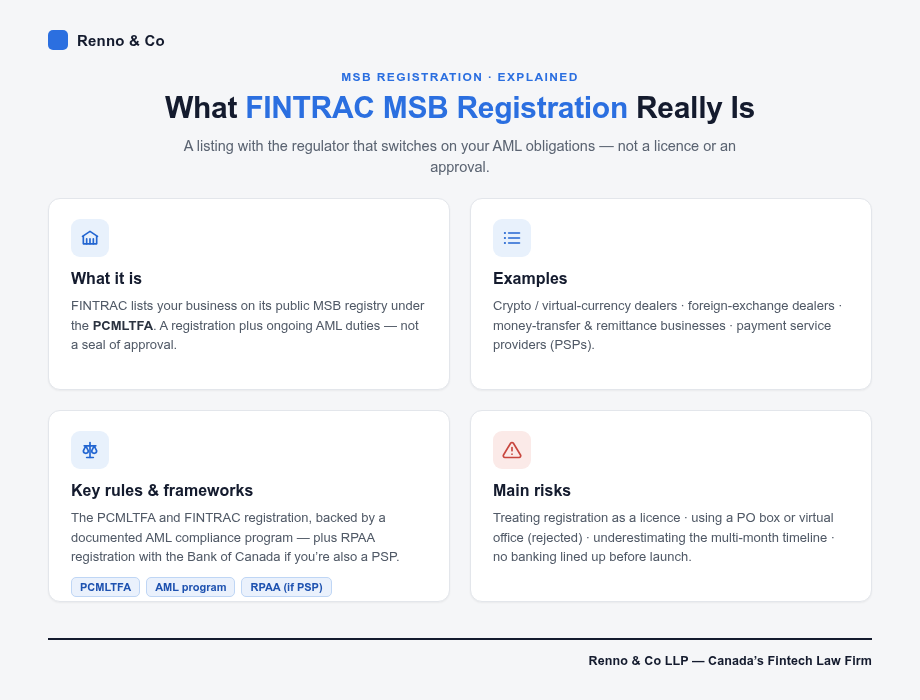
MSB registration is how FINTRAC lists a business that offers money services to the public in Canada. It is required under the Proceeds of Crime (Money Laundering) and Terrorist Financing Act (PCMLTFA). You submit your business and ownership details, build an anti-money laundering program, and take on ongoing reporting duties — a listing plus a set of obligations, not a seal of approval.
Is FINTRAC MSB Registration the Same as an MSB Licence?
No. FINTRAC registers MSBs; it does not licence them. Being registered means you are on FINTRAC's public MSB registry and must follow anti-money laundering rules — not that FINTRAC has reviewed, approved, or endorsed your business model. This distinction matters when you talk to banks, partners, and customers, so use the word “registration,” not “licence.”
Who Needs to Register as an MSB With FINTRAC?
Businesses generally need to register with FINTRAC if they provide regulated money services in Canada, including foreign exchange, money transfers and remittances, crypto trading or transfers, cheque cashing, and certain other services. Foreign businesses serving Canadian customers may also need to register as foreign MSBs.
However, FINTRAC registration is not always enough. Depending on your business model, you may need additional registrations:
- FINTRAC registration only: Businesses offering non-custodial crypto trading, cheque cashing, or non-custodial currency exchange may only require MSB registration.
- FINTRAC + Bank of Canada registration: Remittance companies, fiat pay-in/payout providers, and e-wallet businesses commonly require both MSB registration and payment service provider (PSP) registration under the Retail Payment Activities Act (RPAA).
- Additional securities registration: Certain crypto custody and investment-related business models may also be subject to provincial securities regulation.
FINTRAC registration focuses on anti-money laundering compliance, while RPAA registration focuses on operational risk management and safeguarding customer funds. Which registrations apply depends on the specific activities your business performs.
For a more detailed breakdown of whether you need MSB registration or RPAA registration, including examples of common fintech business models, please read our MSB vs. RPAA in Canada guide.
What Information Does FINTRAC Require for MSB Registration?
Before you start the FINTRAC form, gather the information FINTRAC will actually ask for: your incorporation documents, ownership and control information, directors and senior management, business locations, expected transaction volumes, bank account information if available, and details about your AML Compliance Officer. Having this ready before you file reduces avoidable back-and-forth once FINTRAC opens the formal registration process.
Two early decisions drive the rest of the file: whether you are registering as a Canadian MSB or a foreign MSB, and what business location you will use. The location question deserves separate treatment because FINTRAC's requirements and bank-onboarding expectations are not identical.
Do You Need a Physical Address in Canada for MSB Registration?
You need to separate two questions: what makes you an MSB for FINTRAC purposes, and what address or physical presence will satisfy a bank or payment provider during onboarding. FINTRAC treats a business as having a place of business in Canada if, among other things, it is incorporated in Canada, has a physical location here, or has employees, agents, or branches here. FINTRAC also asks for detailed information about your business locations when you register.
In practice, use a real private office that you actually operate from. If you already operate from a genuine private office outside Canada, that address can generally be used for the FINTRAC file. A PO box or purely virtual mailing address is not a good substitute for an operating location. The harder issue is often banking: many account providers want evidence of genuine Canadian substance, not simply a Canadian corporation or a rented address.
If you do not already have Canadian staff or a Canadian office, the main options are to use your existing genuine foreign office and accept the additional onboarding friction, establish and actually operate from a private Canadian office, or use a Canadian fractional AML service that can provide local compliance leadership and, where included in the engagement, Canadian address support.
For account onboarding, substance matters more than the address alone. An experienced Canadian AML Compliance Officer who actually owns the compliance program can be much more useful than a nominal office with no Canadian compliance function. See how we approach bank account onboarding for Canadian MSBs.
How to Register an MSB With FINTRAC: 9 Steps
You register an MSB with FINTRAC in stages: determine whether you are an MSB or fMSB, prepare the company information, build the AML compliance program, appoint the AML Compliance Officer, submit the pre-registration, respond to FINTRAC's document request, file the full registration package, answer follow-up questions, and wait for confirmation. The steps below follow that order.
Step 1 — Are you an MSB or an fMSB?
Your first decision is whether you are a regular MSB or a foreign money services business (fMSB). The test is simple: if the company is incorporated in Canada, it's an MSB; if it's incorporated outside Canada but directs money services at Canadian customers, it's an fMSB. Most applicants are MSBs. fMSBs face extra steps, including criminal record checks for their leadership.
| MSB | fMSB | |
|---|---|---|
| Where the company is based | In Canada | Outside Canada |
| Who registers | Canadian businesses offering money services | Foreign businesses directing money services at Canadian customers |
| Canadian representative | Not specifically required | Must appoint a Canadian representative |
| Criminal record checks | Not generally required | Required for CEO, directors, and 20%+ owners |
| How common | ~95% of our files | ~5% of our files |
Step 2 — Prepare the company and your registration information
If you do not yet have a Canadian company, you will usually incorporate one before filing as a Canadian MSB. Then assemble the corporate and registration information FINTRAC will ask for: incorporation documents, ownership and control information, directors and senior management, expected transaction volumes, bank account information if available, and details for every business location.
Resolve the physical-presence question before you submit. It is separate from incorporation and can affect both the FINTRAC file and your bank onboarding, so do not leave it until the application is already underway.
Because Renno files as your authorized representative, you will also sign an authorization form that lets us submit and follow up with FINTRAC on your behalf. You can see the full scope of our Canadian MSB registration service here.
Step 3 — Prepare your AML compliance program
You need an AML compliance program, not just an AML policy. FINTRAC requires an appointed compliance officer, written policies and procedures, a documented risk assessment, an ongoing training program and plan, and a plan for a two-year effectiveness review. Your procedures also need to cover the KYC, reporting, record-keeping, and ongoing monitoring obligations that apply to your business model.
Build the program in parallel with the registration. FINTRAC requires MSBs to implement it, and banks and payment providers commonly ask for the AML policy and risk assessment during onboarding. We prepare the AML compliance program alongside the registration so you are not building it after the FINTRAC file is already moving. See FINTRAC's compliance program requirements for the current regulatory elements.
Step 4 — Appoint your AML Compliance Officer
FINTRAC requires every reporting entity to appoint a Compliance Officer who is responsible for implementing the AML compliance program, and the MSB registration form asks for that person's information. This is an operating role, not a name you add to the application: the officer needs enough authority, access, and AML knowledge to run the program and escalate issues to senior management.
Your Compliance Officer does not have to be Canadian. But if your owners and operating team are outside Canada, having an experienced Canadian Compliance Officer can strengthen bank and payment-provider onboarding because the provider has a local person who understands Canadian AML requirements and can answer diligence questions. If you do not have that person in-house, Renno's fractional AML services can provide the Compliance Officer and compliance team on an outsourced basis.
Step 5 — Submit your FINTRAC pre-registration
Pre-registration is a short online form that opens your file with FINTRAC. You enter your business structure (Corporation), your exact legal and operating name, your operating address, a business phone number, your email and website, whether you're an MSB or fMSB, and the services you offer. You also pick a start date for offering MSB services, which must fall within three months. A FINTRAC representative then contacts you to continue.
A few details matter more than the rest:
- Your legal name and email must be exactly correct — other details can be adjusted later, but these two cannot be wrong.
- A phone number is required; if you don't have a business line yet, a number from your website works.
- For a brand-new registration, you'll answer “no” to whether you've applied to FINTRAC before.
When you submit, download and save a copy of your answers as your record of what you filed and when.
Step 6 — Get portal access and FINTRAC's document request
After pre-registration, FINTRAC typically takes one to three months to reach out through the Canada Post Connect portal to request your supporting documents. You can't speed this up, but don't sit idle: use the wait to prepare your full registration form and corporate package (Step 7) so you can respond the moment FINTRAC opens the portal.
If you're an fMSB, this is also when you line up criminal record checks for your CEO, directors, and any 20%+ owners. These need to be current — generally no more than six months old — so timing them to the portal opening avoids re-ordering.
Step 7 — File your full registration
Once FINTRAC requests your documents, you submit the full package through the Connect portal. The core documents are your completed MSB registration form, the signed authorization form, and a corporate document package (the “2C package”) covering your CEO, directors, officers, and every person or entity owning or controlling 20% or more of the company.
The corporate package usually pulls together:
- Articles of incorporation
- Directors, officers, and shareholder registers
- Resolutions of the directors and shareholders
- Corporate documents for any entity owning 20% or more
- Criminal record checks and other extra documents, if you're an fMSB
Only submit documents that have been reviewed and are accurate — a clean first submission avoids back-and-forth and keeps your timeline on track.
Step 8 — Respond to clarification requests
FINTRAC often comes back with follow-up questions or additional document requests before it finalizes your file. Your authorized representative handles these through the portal, keeps a consistent point of contact, and follows up on a regular schedule while the file is under review. Responding quickly and completely is the single biggest thing within your control to keep the registration moving.
Step 9 — Registration confirmed
When FINTRAC finishes its review, it confirms your registration by email. Your business is then added to FINTRAC's public MSB registry, though it can take one to two months to appear there. Remember what this does and doesn't mean: you are registered and subject to ongoing AML obligations (reporting, record-keeping, and keeping your compliance program current), but FINTRAC has not “approved” or endorsed your business.
At this point, registration is done — but going live usually depends on the next steps below.
How Long Does FINTRAC MSB Registration Take?
Plan for several months, not weeks. The slowest parts are outside your control: FINTRAC takes one to three months after pre-registration just to request documents, and more time to review your full submission. A law-firm-managed file generally moves faster than a do-it-yourself application, largely because the paperwork is right the first time.
This is often where expectations need a reset. Take a crypto trading firm we'll call Rampart Digital, which was losing its European operating base to a regulatory change and needed to relaunch somewhere reputable on a tight deadline. They came in expecting registration to take a few weeks, because their whole go-live plan depended on it. The honest answer changed the plan: even a well-run file runs several months, and much of the pace sits with FINTRAC, which can take one to three months just to issue its document request. The one lever firmly in your control is a clean, professionally managed submission that doesn't bounce back for corrections — so their focus shifted from “how fast can this be rubber-stamped” to “how do we start early and run banking alongside registration.”
Because processing times shift, check our dedicated guide on current MSB registration processing times for the latest picture before you plan your launch date.
How Much Does FINTRAC MSB Registration Cost?
FINTRAC does not charge a government filing fee to register an MSB. Businesses may still incur costs for incorporation, legal or compliance support, AML program development, criminal record checks where applicable, and banking or onboarding work.
What Happens After Your MSB Is Registered?
Registration is the start line, not the finish line. Once you're registered, the next steps are usually banking, any additional registrations, and keeping your AML program live.
What about banking? Getting registered is only half the battle — you still need banking or payment rails before you can move money, and it's one of the hardest parts of the process. Banks and account providers screen MSBs carefully and often restrict cross-border payments, crypto flows, certain jurisdictions, and cash handling. We've helped many clients get banked — see how we help you open a bank account for your MSB.
If your payment model also brings you under the Retail Payment Activities Act (RPAA), you may also need to register with the Bank of Canada as a payment service provider (PSP). If both apply, Renno offers a combined MSB + RPAA registration package that prepares both the AML policy and the operational risk management framework.
What Is the FINTRAC MSB Registry?
The FINTRAC MSB Registry is the public database used to check the registration status of Canadian and foreign money services businesses. It is separate from the registration process itself. You can use FINTRAC's Money Services Business Registry to verify whether a business is currently registered and review its listed status.
How Renno & Co can help
If you know you need to register and want it done right the first time, we manage the full process end to end — fact-gathering, incorporation where needed, AML materials, pre-registration, FINTRAC's document requests, full submission, and follow-ups through to approval — and help you get bank-ready afterward. It's the same start-early, run-things-in-parallel approach that kept Rampart Digital's relaunch on track.
Learn more about our FINTRAC MSB registration services in Canada.
If you're planning to register as an MSB in Canada, book a call and we'll map your structure, services, and realistic timeline before you file — or fill out our form and we'll get in touch.
This content is for informational purposes only and does not constitute legal advice.
Ready to get started?
Talk To UsBook a Free Consultation
Speak with our fintech legal advisor
about your registration


