


Our mission is to help Canadian fintech companies get registered, go live, and stay compliant.
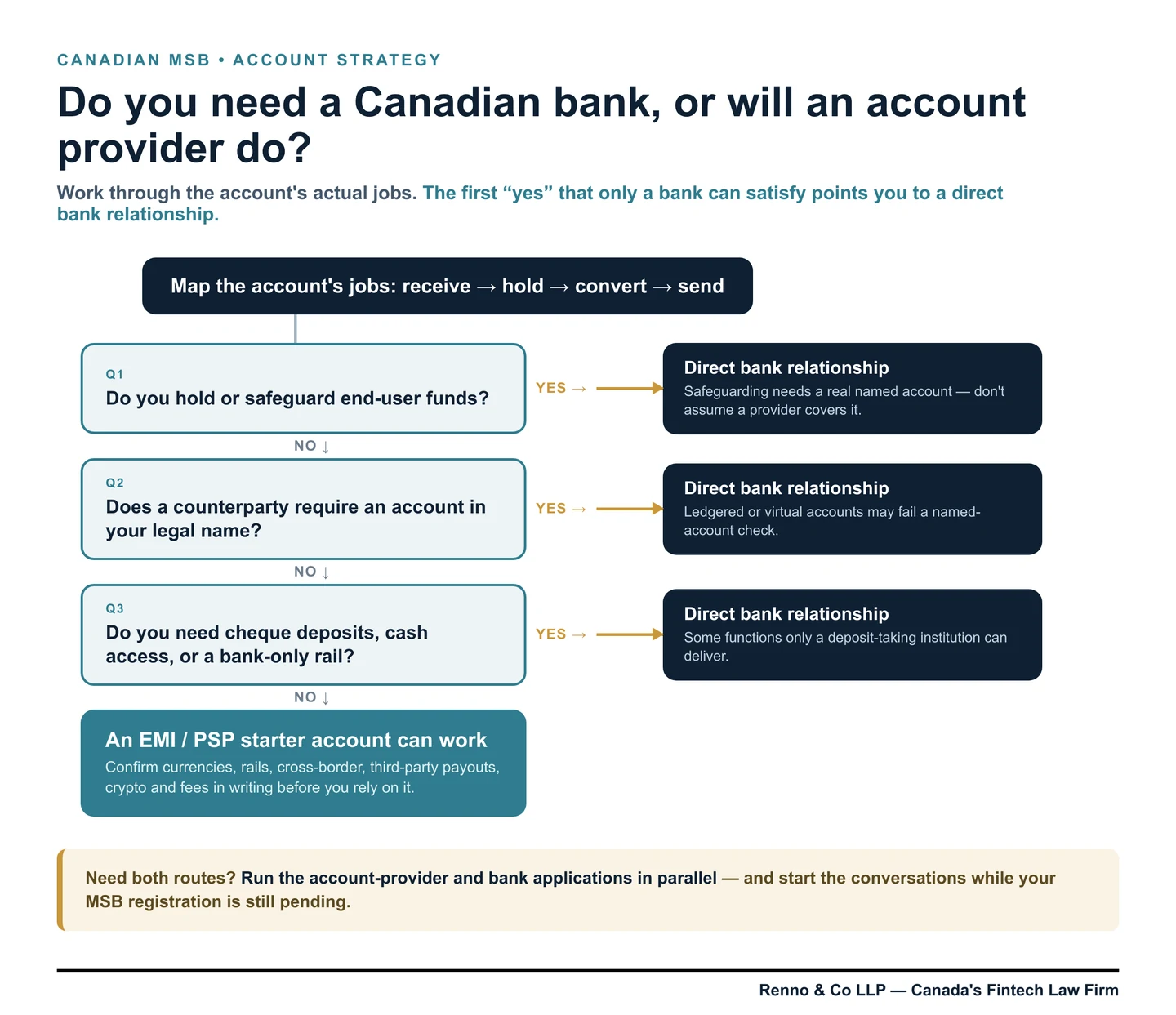
Opening a bank account for a Canadian MSB starts with a more basic decision: do you need an account directly with a bank, or would an account from a non-bank account provider work? An electronic money institution (EMI) or payment service provider (PSP) can provide the collection, payout, foreign-exchange, and operating rails that many early-stage companies need. A direct bank relationship is harder to obtain, but it may be necessary for safeguarding, a clearly named account, cheque or cash services, or other functions a non-bank provider cannot support.
Do not treat bank onboarding as the automatic next step after registration. First map the payment flow and define the exact jobs the account must perform. Then choose the provider type that fits those jobs and confirm its restrictions before applying.
2026 update: what changed?
This article now starts with the decision between a direct bank account and a non-bank account provider. It explains why an EMI or PSP can be a practical starter account for an early-stage company, when a direct bank relationship becomes necessary, and how safeguarding, named-account requirements, payment rails, Canadian presence, and compliance readiness affect the choice.
Should a Canadian MSB use a bank or an account provider?
For many early-stage Canadian money services and payment businesses, a non-bank account provider is the practical starting point. An EMI, PSP, or similar fintech may provide the operating, collection, settlement, payout, and foreign-exchange functions needed to launch. A direct bank account is usually harder and slower to obtain, but it can become necessary when the business needs a safeguarding account, a clearly named account, direct access to particular rails, or services that depend on a deposit-taking institution.
| Option | Usually makes sense when | Main limits to test |
|---|---|---|
| EMI, PSP, or other non-bank account provider | Makes sense whenThe company is early-stage and needs a workable starter account for collections, payouts, settlement, foreign exchange, or operating expenses | Limits to testThe account may sit on top of the provider’s own bank relationship; it may not be a named bank account and usually should not be assumed to work for safeguarding |
| Bank, credit union, or trust company | Makes sense whenThe business needs a safeguarding account, a direct named relationship, cheque services, cash access, or a stronger long-term banking foundation | Limits to testBanks are generally more selective with MSBs, may require operating history, and can take substantially longer to approve an application |
| Both in parallel | Makes sense whenThe company needs to launch with non-bank rails but expects to need a bank for safeguarding or other specialized functions | Limits to testEach provider must approve the actual payment flow; one account cannot be assumed to solve every function |
The practical answer is often not “bank or fintech forever.” It is “which provider is right for me now?” A non-bank provider can serve as the starter account while you pursue a direct bank relationship as a separate workstream for safeguarding or other bank-only needs.
Consider a cross-border remittance group we’ll call CedarBridge Remit — a Gulf-headquartered, multi-market remittance business that was starting up a Canadian MSB so it could collect CAD from Canadian corporate customers, convert it to USD, and route payouts abroad through its own treasury. Its most pressing question was not registration. It was banking: who would actually give a Canadian MSB an account, and could it simply keep using the providers it already worked with in other markets?
The realistic answer was to avoid betting the launch on a single institution. A traditional bank relationship was possible but harder to obtain, because banks treat MSBs as higher risk; other MSB-friendly options existed but came with meaningful ongoing costs; and non-bank payment providers usually onboard faster. So the practical play was to run a payment-provider application and a bank application in parallel rather than depend on one outcome. Its existing foreign relationships were relevant, but each provider still had to confirm it would support the new Canadian entity and the proposed flow — a relationship with the group abroad did not automatically extend to the Canadian company, Canadian customers, or CAD collections.
What is the difference between a direct bank account vs. an intermediary (like an EMI)?
You hold a direct bank account with a deposit-taking institution such as a bank, credit union, or trust company. A non-bank account provider—such as an EMI or PSP—usually gives you (being an MSB) access to accounts and payment rails through an intermediary structure that ultimately relies on one or more banks. The non-bank route can be more accessible and flexible, but it adds another provider layer with its own rules, costs, and dependencies.
A simple way to think about the difference is wholesale versus retail:
- With a bank, the business deals directly with the institution that holds the account and connects to the underlying fiat payment system.
- With an EMI or PSP, the business obtains services from a provider that is itself relying on a bank or other financial institution behind the scenes.
- The intermediary can make onboarding and payment functionality more accessible, but the business inherits both the intermediary’s rules and the limits imposed by its back-end bank.
This distinction matters when another provider insists that payments come from or go to an account clearly held in the MSB’s legal name. Some fintech arrangements provide only a ledger balance, virtual account detail, or access to an account legally held by the provider. That can work for many payment flows, but it may fail a counterparty’s named-account requirement.
Why can an EMI or PSP work as a starter account?
An EMI or PSP can make sense for an early-stage company because the provider may be more willing than a bank to onboard a pre-operational or newly launched MSB. Depending on the provider, it may also offer several services in one relationship, including local collections, international payouts, foreign exchange, multiple currencies, and online account administration. This can give the company enough infrastructure to begin operating while it builds history and pursues a direct bank relationship.
A starter account is not a lesser account in every respect. It is simply an account chosen to solve the company’s immediate launch needs. Before relying on it, confirm:
- Which currencies and local payment rails are supported.
- Whether the account can receive funds from the MSB’s customers or other third parties.
- Whether the provider permits outbound payments to beneficiaries, merchants, liquidity providers, or the MSB’s own foreign accounts.
- Whether cross-border payments are allowed and whether payments must stay local.
- Whether the provider supports the company’s customer types, industries, countries, and crypto exposure.
- Whether counterparties will accept the account details as a named account.
- Which fixed, percentage-based, monthly, minimum, foreign-exchange, and transaction fees apply.
An early-stage company should not choose a provider only because onboarding appears easier. The account must still support the real flow of funds. If one restriction breaks the receive, hold, convert, or send sequence, the product may not be able to operate as designed.
When does a Canadian MSB need a bank account?
A Canadian MSB may need a direct bank relationship when a non-bank account provider cannot deliver a required legal or operational function. The clearest example is safeguarding end-user funds. A bank relationship may also be required for a named account, cheque deposits, access to cash, or a counterparty that refuses to send money to or receive money from an intermediated account.
Safeguarding end-user funds
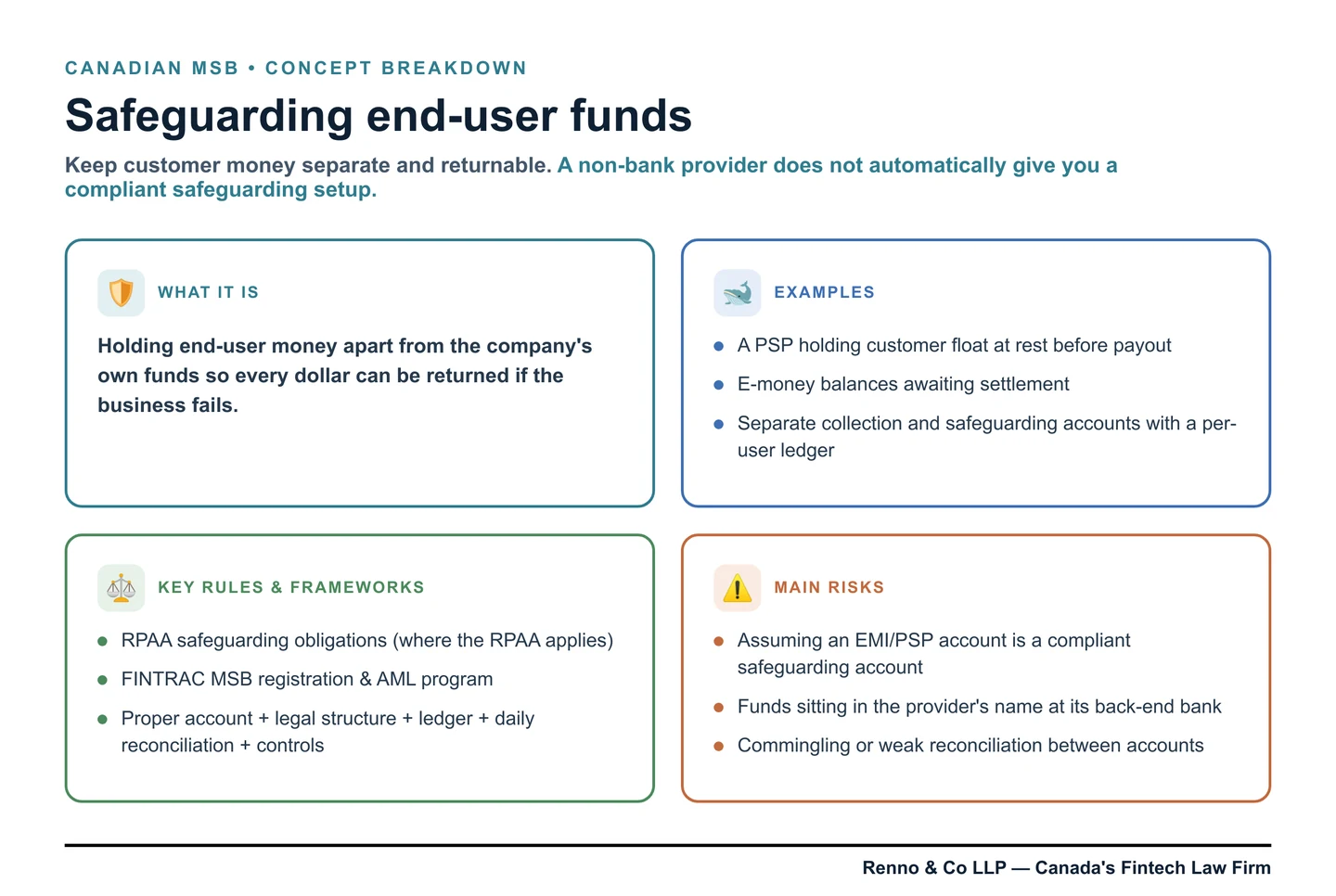
Safeguarding means keeping end-user money separate from the company’s own money so it can be returned if the company fails. If a PSP holds end-user funds at rest, the safeguarding setup is more than a second account. It normally combines an appropriate account, a legal structure, a ledger that records each user’s balance, reconciliation, and controls for moving funds between collection and safeguarding accounts.
Do not assume a non-bank account provider will provide an RPAA-compliant safeguarding account. The account may ultimately sit in the non-bank provider’s own name at its back-end bank, and the arrangement may not give the MSB the legal structure or direct relationship it needs. Where safeguarding applies, identify that requirement before choosing the provider—not after customer funds have started moving.
Named-account requirements
A counterparty such as a card acquirer or another payment provider may require settlement to an account clearly titled in the MSB’s legal name. A direct bank relationship usually provides the clearest named-account structure. Some non-bank providers offer virtual or ledgered accounts that look account-like to the MSB, but not every counterparty treats them as a direct account in the MSB’s name.
Cheques, cash, and specialized services
Cheque-cashing businesses may need a bank that can accept deposited cheques and support the cash-withdrawal process. Other businesses may need direct access to particular local rails, a qualifying safeguarding structure, or a stronger long-term account relationship. List these functions separately rather than bundling them into a vague request for “banking.”
What account functions do you actually need?
Before contacting providers, divide the account request into specific functions. Different accounts can perform different jobs, and one provider may not support all of them.
- Map the flow of funds. Show who sends money, who receives it, where funds are held, when conversion occurs, which entity owns each account, and whether money ever remains at rest.
- Identify the receive function. Define whether the MSB collects from consumers, businesses, acquirers, foreign payment providers, or accounts held in its own name.
- Identify the hold function. Confirm whether the company holds end-user balances and, if so, whether a safeguarding account and daily reconciliation process are required.
- Identify the convert function. State whether conversion is fiat-to-fiat, fiat-to-crypto, crypto-to-fiat, or handled through a separate liquidity provider.
- Identify the send function. List the beneficiary types, countries, currencies, local rails, and cross-border routes the provider must support.
- Separate operating money from customer money. An account used to pay rent, payroll, and vendors is not automatically suitable for collections, settlement, or safeguarding.
This map lets the provider assess the real business instead of a generic description. It also exposes gaps early. For example, a Canadian account provider may support CAD collections but refuse cross-border payments, third-party payouts, crypto-linked flows, or transfers involving certain countries or industries.
What restrictions should you test before applying?
Most account providers apply a risk policy that is narrower than what the law permits. A provider can still reject a registered company because its model, customers, countries, currencies, or payment flow falls outside its appetite. Test the restrictions before spending time on a full application.
Common blockers include:
- The provider does not onboard MSBs or only accepts established companies with operating history.
- The account can use local rails but cannot send funds across borders.
- Cross-border payments are allowed only between accounts held in the MSB’s own name, not to third-party beneficiaries.
- The provider will not accept direct payments from individual consumers.
- Crypto is prohibited through the provider’s rails or prohibited across the MSB’s business entirely.
- Certain jurisdictions, customer sectors, or high-risk industries are not supported.
- The required currency is unavailable.
- The account is not a named account and will not satisfy a counterparty’s settlement requirements.
- Contract terms impose high minimum fees, long commitments, or exclusivity.
Ask for written confirmation of the proposed flow wherever possible. A general statement that the provider “works with fintechs” or “supports MSBs” does not confirm that it accepts your specific product.
What will a bank or account provider review?
Banks and non-bank providers generally assess the legal entity, owners, managers, business model, customers, countries, projected volumes, payment flow, compliance program, and Canadian presence. The application, website, contracts, policies, regulatory filings, and flow-of-funds diagram should describe the same business. Contradictions create delays and can undermine confidence in the application.
Prepare a provider-ready package that includes:
- Corporate documents and an ownership chart.
- Identification and background information for directors, officers, and beneficial owners.
- A business plan describing the product, customers, countries, currencies, revenue model, and expected transaction activity.
- A written and visual flow of funds.
- FINTRAC MSB registration information and, where applicable, Bank of Canada RPAA registration information.
- The AML compliance program and details about the compliance officer and team.
- The operational risk and safeguarding framework where applicable.
- Financial statements, forecasts, source-of-funds information, and key partner contracts.
- Proof of a credible Canadian operating address, such as a lease, sublease, utility record, or other supporting evidence.
Many providers care about the real operating story behind the address. A registered office or virtual address may satisfy one filing purpose but still fail the provider’s request for evidence of a genuine Canadian operating presence. So handle address planning, compliance staffing, and account onboarding together. See here for more details on substance requirements that account providers may have.
This is where CedarBridge Remit hit a second, easily missed blocker. The company had set up the Canadian entity on a virtual office address, and account providers routinely want a real private office with documentary proof of address before they will onboard. The lesson is that account strategy, entity structure, Canadian presence, and compliance readiness must be designed together — registration alone does not guarantee banking, and a paper-only address can stall an otherwise strong application.
Should registration and account onboarding happen at the same time?
Registration and account onboarding should usually run as related but separate workstreams. Most account providers will want to see proof of your MSB registration and AML policy before they onboard you, so registration generally has to come first. You do not have to wait for approval to begin, though: you can open conversations with many providers while your registration is still pending, which often shortens the overall timeline. Just be accurate about what is complete and what remains in progress, and where the RPAA applies, expect the provider to also ask about your PSP registration status, operational risk framework, and safeguarding arrangements.
The most practical sequence is:
- Confirm which registrations apply to the business model.
- Map the payment flow and identify every required account function.
- Prepare your AML policy, operational risk management framework, notarize your corporate documents, and other docs you can expect account providers to ask for.
- Shortlist providers whose capabilities and restrictions fit your flow.
- Apply to suitable non-bank providers and banks in parallel where the business needs both.
Renno’s combined MSB and RPAA registration service includes the AML policy required for the MSB workstream and the operational risk management framework required for the RPAA workstream. We can also help you get onboarded with the right provider! Click here to reach out and learn more.
How should you choose and verify an account provider?
Choose a provider by matching its legal authority, capabilities, and restrictions to the services it will actually perform. Registration is not the same as reliability, and a sales promise is not proof that the provider can lawfully or operationally support the flow. Verify the relevant regulatory status, review their contract (we can help with this), look into adverse media, and understand which bank or financial institution sits behind them (where you’re dealing with an intermediary like an EMI).
At minimum:
- Confirm what the provider will do across receive, hold, convert, and send.
- Verify the registrations or licences that cover those functions.
- Confirm the legal entity that will contract with the MSB and hold or move funds.
- Review the provider’s back-end dependencies and any limits inherited from its bank.
- Check fees, reserves, termination rights, exclusivity, and service restrictions.
- Review credible public information for legal, regulatory, insolvency, fraud, sanctions, or reliability concerns.
- Maintain an alternative provider path where a single relationship would create a launch-critical dependency.
What should a Canadian MSB do before applying?
Before applying, decide whether the immediate need is a starter account, a direct bank relationship, or both. Do not ask for “a bank account” until the receive, hold, convert, and send functions are clear. A focused application to a suitable provider is more useful than broad applications to institutions that do not support the model.
Use this final readiness check:
- The entity and ownership structure are stable and documented.
- The MSB and RPAA analyses are complete, and required applications are underway.
- The account functions and flow of funds are clear.
- Any safeguarding requirement has been identified and separated from ordinary collections and operating expenses.
- The selected provider supports the required customers, countries, currencies, rails, and crypto exposure.
- Named-account requirements have been confirmed with counterparties.
- The compliance officer, AML program, operating address, and supporting evidence are ready.
- The company has enough time and cash runway for follow-up review and does not depend on one assumed approval date.
If you are deciding between a starter account with an EMI or PSP and a direct bank relationship, Renno can assess the payment flow, safeguarding needs, Canadian presence, and provider fit before applications are submitted. Learn more about our bank and account-provider onboarding support, or book a call to plan the right account path for your Canadian launch.
This content is for informational purposes only and does not constitute legal advice.
Ready to get started?
Talk To UsBook a Free Consultation
Speak with our fintech legal advisor
about your registration


