


Our mission is to help Canadian fintech companies get registered, go live, and stay compliant.
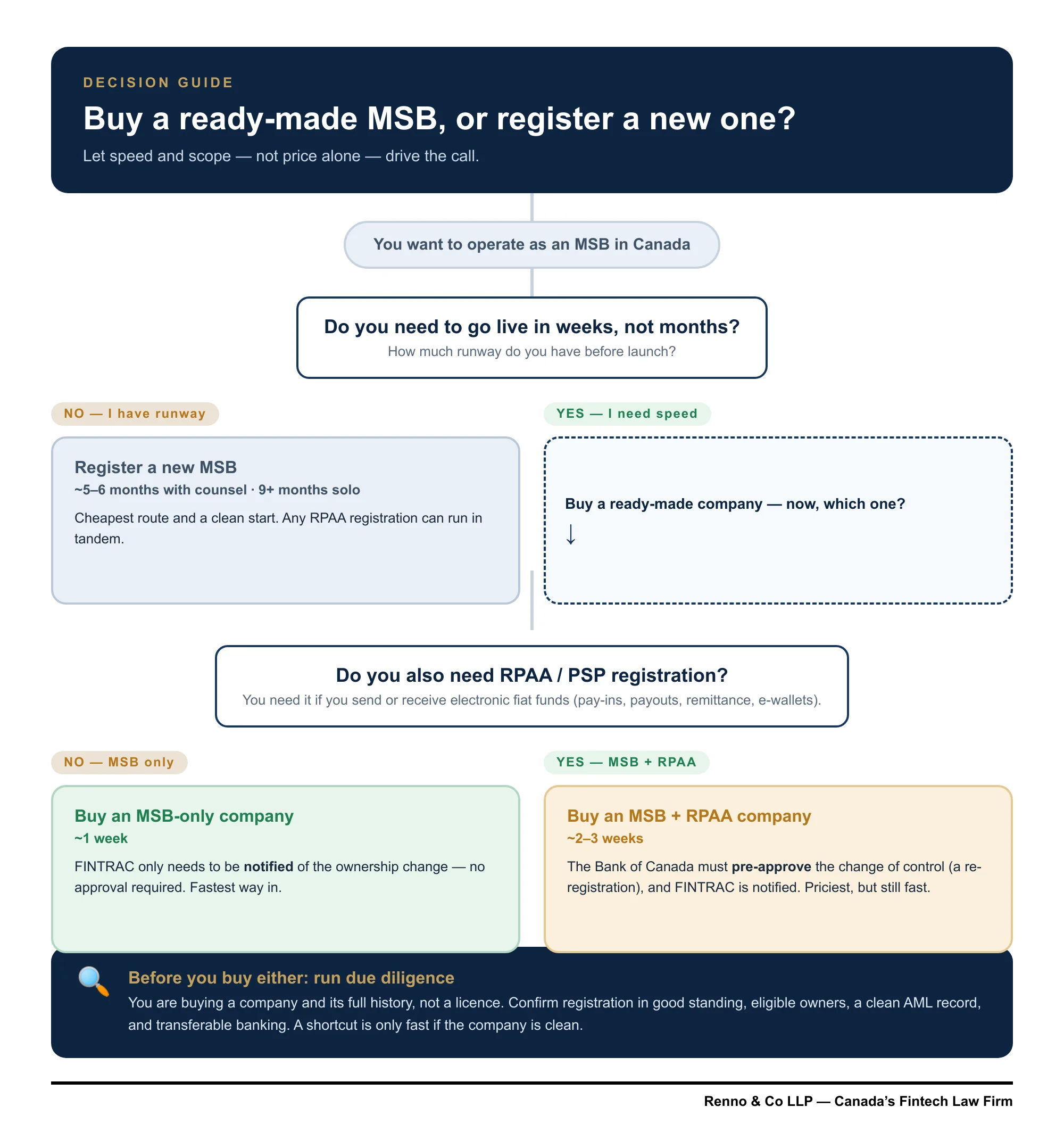
If you want to operate in Canada quickly, buying a ready-made MSB — an existing company that already holds a money services business (MSB) registration with FINTRAC, Canada’s anti-money-laundering regulator — is usually faster than filing a new registration. A clean MSB can change hands in about a week, because FINTRAC only needs to be notified of the ownership change, not asked to approve it. Registering a new MSB currently takes about five to six months when a law firm manages the file.
One caveat up front. If the company also holds a payment service provider (PSP) registration under the Retail Payment Activities Act (RPAA), the process changes: a change of ownership there needs the Bank of Canada to approve it first. This guide compares buying a ready-made MSB against registering from scratch, sets out realistic timelines, and explains what you should check before you sign anything.
Are you buying an MSB licence, or a company?
You are buying a company, not a transferable licence. In Canada, an MSB registration attaches to a specific legal entity, not to a person who can hand it over. When you “buy a ready-made MSB,” you are acquiring the shares of a company that already holds the registration. The registration stays with the company, and you simply become its new owner. That distinction drives almost everything else in this article.
This matters because a FINTRAC MSB registration is a listing, not an approval or a seal of quality. FINTRAC does not vouch for the business; it records that the company is registered and must follow Canada’s anti-money-laundering rules. So there is no “licence” sitting on a shelf to be sold on its own. What is for sale is the corporation that carries the registration.
The practical upside is real: because FINTRAC only needs notice of a change in ownership — not an approval — a clean MSB-only company can transfer quickly. The practical risk is just as real: you inherit whatever that company has done, filed, or failed to file. And if the company is also RPAA-registered, a plain “notice” is not enough — the Bank of Canada has to sign off first. We come back to both points below.
Take a team we will call NorthVault — a group building a cross-border payments business on top of an existing advisory business. They looked at three ways into Canada: buy an MSB-only company, buy a company that held both MSB and RPAA registrations, or register a brand-new entity from scratch. As you will see, the “getting registered vs buying ready-made” distinction shaped every part of their decision.
Is buying an existing MSB faster than registering a new one?
Yes. A clean, MSB-only company can transfer in roughly a week, because FINTRAC does not need to approve a change of ownership — it only needs to be notified. A fresh MSB registration currently takes about five to six months when a law firm manages the application, and market feedback suggests do-it-yourself applicants can wait nine months or more. For a team that needs to go live now, closing that gap is the entire appeal.
The reason comes back to that notice-versus-approval difference. With a new registration, you cannot legally offer covered services until FINTRAC has processed and completed the registration, so you sit through months of dead time. With a share purchase of an already-registered company, the registration already exists — you are changing who owns the company that holds it, and FINTRAC is informed of that change.
One honest qualification: “faster” assumes the company is clean. If the target has messy filings, compliance gaps, or a problematic history, sorting that out can cost you more time and money than starting fresh — which is why the due diligence section below is not optional. For NorthVault, speed-to-market, not price, was the deciding factor, so a quick, clean transfer was worth paying for.
How long do the two options take?
The short version: buying an MSB-only company can usually be done in about a week, buying an MSB-plus-RPAA company adds a short Bank of Canada step, and registering from scratch can take months. The table below lays out the three paths side by side. All timelines are as of the last-updated date at the top of this article and reflect what we are seeing in practice, not fixed rules.
| Option | Rough timeline | Key regulator step | Relative cost | Best for |
|---|---|---|---|---|
| Buy an MSB-only company | Rough timelineAbout 1 week | Key regulator stepFINTRAC is notified of the ownership change — no approval needed | Relative costHigher upfront than a DIY filing | Best forTeams that need to operate almost immediately |
| Buy an MSB + RPAA company | Rough timelineAbout 3 weeks | Key regulator stepBank of Canada must pre-approve the change of control (a re-registration). FINTRAC also needs to be notified. | Relative costPriciest of the three | Best forTeams that need both MSB and PSP status fast |
| Register a new MSB | Rough timelineAbout 5–6 months with counsel (9+ months solo) | Key regulator stepFull FINTRAC registration from scratch | Relative costCheapest | Best forTeams with runway who want a clean start |
If you register new and also need PSP status, note that a fresh RPAA registration is currently taking roughly two months in practice — so for a new build, MSB registration is usually the longer pole in the tent.
The trade-offs were stark for NorthVault. An MSB-only company transferred in about a week on a simple FINTRAC notice. A company holding both MSB and RPAA registrations was pricier and needed the Bank of Canada to pre-approve the change of control, which took a few weeks. Registering from scratch was the cheapest option but could take many months. Because their priority was getting to market, the fast, clean transfer won.
Does buying an MSB also cover RPAA?
Not automatically. MSB registration with FINTRAC and PSP registration under the RPAA are two separate registrations, with two different regulators, doing two different jobs. FINTRAC’s registration is about anti-money-laundering compliance. The RPAA is about operational risk and safeguarding customer funds. Buying a company that is only MSB-registered does nothing to give you RPAA status, and buying one that is RPAA-registered triggers an extra approval step.
Whether you need the RPAA at all depends on your product. As a rough rule, if you help clients send or receive electronic fiat funds — pay-in products, payout products, and most remittance and e-wallet models — you likely need to register as a PSP with the Bank of Canada. If you only do something like non-custodial crypto trading or currency exchange, you may need MSB registration but not the RPAA.
Here is the part that catches buyers off guard. A change of control — broadly, a change of more than a third of the ownership — in an RPAA-registered company must be pre-approved by the Bank of Canada. In practice the company has to resubmit its entire registration application with the new owners and the business they plan to run. That process is called re-registration, and the new owners cannot legally close the deal and start providing payment services until it is approved. The upside is that the Bank of Canada currently prioritizes these applications — because it knows acquisitions hinge on them — and re-registration is running at roughly two weeks, meaningfully faster than the ~2 months for a fresh RPAA registration.
So buying an MSB-plus-RPAA company can still make sense; it just is not the one-week, notice-only exercise that a clean MSB-only purchase can be. If you decide you need both registrations, Renno offers a combined MSB + RPAA registration package that also includes preparing the AML compliance program required for MSB registration and the operational risk management framework required under the RPAA. We may also know folks who have MSBs available for sale we can put you in touch with! To learn more, book a call or fill our form (and we’ll get in touch).
What still has to be updated after the purchase?
Closing the deal is the start, not the finish. Even with a clean MSB, you will usually need to notify FINTRAC of the ownership change and update the company’s registration details, refresh its AML compliance program so it matches how you will actually operate, sort out its business address and Canadian presence, and re-paper or re-apply for its banking and account-provider relationships. Skipping these steps is how a “fast” purchase quietly turns into a slow, risky one.
Here is what typically needs attention:
- Registration details with FINTRAC. Update ownership, directors, and the services listed on the registration. If your model involves crypto, for example, the registration needs “virtual currency” selected under services offered — and that public detail is something banks look at.
- AML compliance program. The registration attaches to the entity, but the anti-money-laundering program has to reflect your business. You also inherit the company’s ongoing obligations — know-your-customer, transaction monitoring, reporting, and periodic AML effectiveness reviews — from day one.
- Business address and Canadian presence. The FINTRAC business address has to be a real physical place tied to actual business or compliance activity, and it appears on the public FINTRAC registry.
- Banking and account providers. Existing accounts may not simply carry over. Providers usually re-run due diligence when ownership changes, and some contracts carry multi-year lock-ins or exclusivity terms you will inherit.
- RPAA, if applicable. As covered above, an RPAA-registered target means a Bank of Canada re-registration before you can operate.
Two things regulators and banks keep coming back to are a genuine Canadian presence and a credible AML function. Many account providers expect a real Canadian operating address and AML compliance already in place, and FINTRAC expects a real physical place of business — a PO box or virtual address will not do.
To learn more about how to establish physical presence that satisfies FINTRAC and your bank/account providers, see here.
If you’d like to reach out and discuss how we can help, book a call or fill our form (and we’ll get in touch).
What about banking?
Getting — or keeping — banking is often the hardest part of the whole exercise. Registration, whether bought or filed, is only half the battle; you still need banking or payment rails before you can go live, and most banks treat MSBs as a high-risk category. A target company’s existing accounts may not survive a change of ownership, so you can end up registered but unbanked. We are connected with a network of banks and account providers and have helped a range of clients get banked.
What due diligence should a buyer do?
Because you are buying a whole company, you inherit its whole history. Before you sign, confirm the company is genuinely registered and in good standing, that its owners and directors are not ineligible under Canada’s anti-money-laundering law, that its past compliance and FINTRAC filings are clean, that its banking relationships are real and transferable, and that it carries no hidden corporate, tax, or regulatory liabilities. Good due diligence is what separates a shortcut from a landmine.
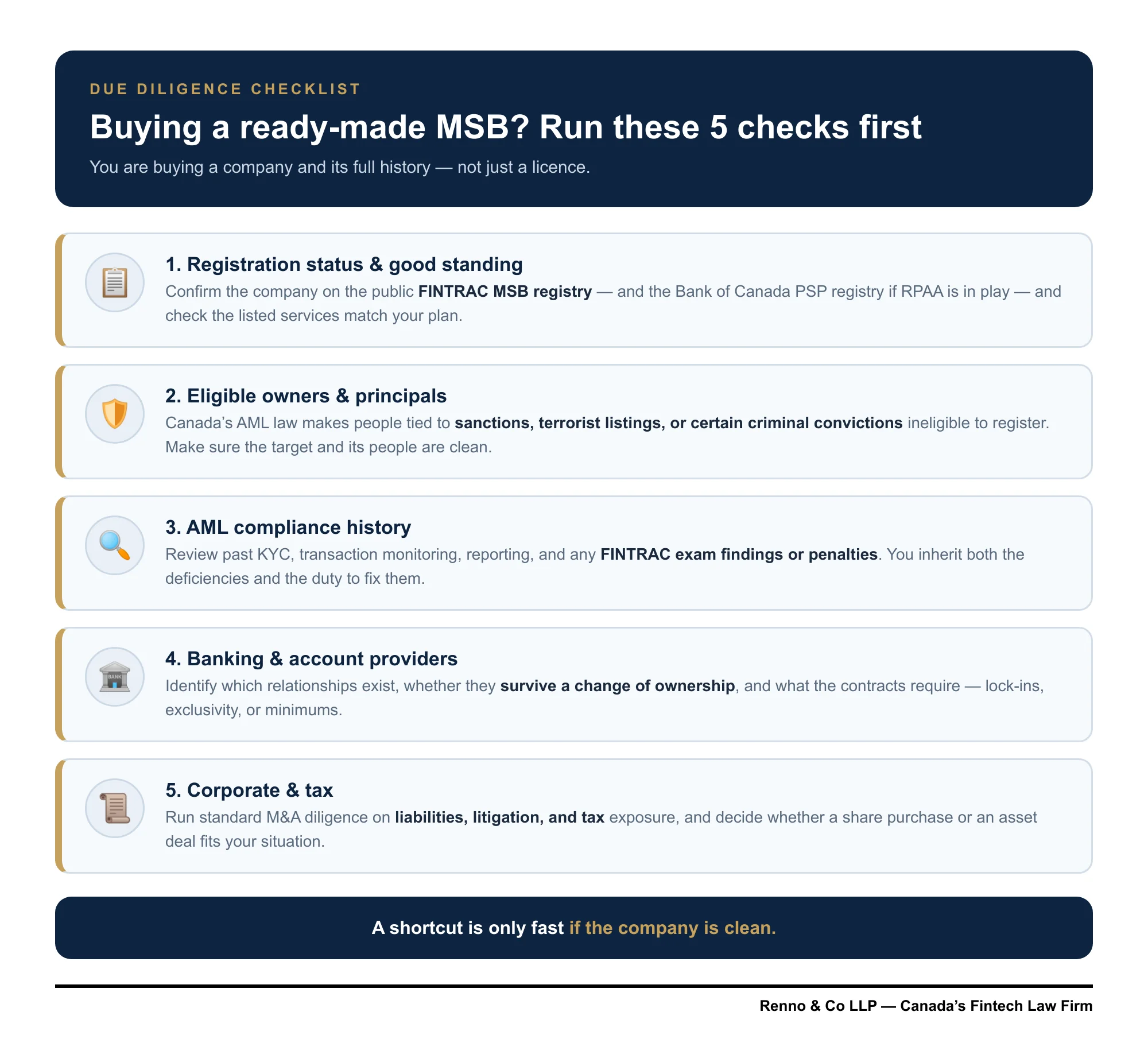
At a minimum, work through:
- Registration status and good standing. Confirm the company on the public FINTRAC MSB registry, check that the services listed match your plan, and — if the RPAA is in play — check the Bank of Canada’s PSP registry and applicant list.
- Eligibility of the owners and principals. Canada’s anti-money-laundering law makes certain persons and entities ineligible for registration, including those tied to sanctions, terrorist listings, or specific criminal convictions. Make sure the target and the people behind it are clean.
- AML compliance history. Review past know-your-customer records, transaction monitoring, reporting, and any FINTRAC examinations, findings, or penalties. You inherit both the deficiencies and the duty to fix them.
- Banking and account-provider relationships. Identify which relationships exist, whether they survive a change of ownership, and what the contracts require (lock-ins, exclusivity, minimums).
- Corporate and tax. Run standard acquisition diligence on liabilities, litigation, and tax exposure, and decide whether a share purchase or an asset deal fits your situation.
For NorthVault, the analysis came down to speed — but they only got comfortable after doing this work. A clean MSB-only company that transferred in about a week, on a simple FINTRAC notice, beat both a pricier MSB-plus-RPAA company that needed Bank of Canada pre-approval and a from-scratch registration that could take many months. The shortcut was only worth taking once diligence confirmed there was no problem hiding inside the company.
The bottom line
Buying a ready-made MSB can save you months — or it can hand you someone else’s compliance problem. You are not buying a licence; you are buying a company that holds a registration, and notices to FINTRAC or a full Bank of Canada re-registration may still stand between you and going live. The right choice depends on how fast you need to operate, whether you also need RPAA status, and how clean the target turns out to be.
If you are comparing a ready-made MSB against a fresh registration, book a call before you sign a share purchase agreement. We can review the target, map out the change-of-ownership steps, and give you a realistic path to going live — whether that means buying, building, or a combined Canadian MSB registration and RPAA package.
Disclaimer: This content is for informational purposes only and does not constitute legal advice.
Ready to get started?
Talk To UsBook a Free Consultation
Speak with our fintech legal advisor
about your registration


