


Our mission is to help Canadian fintech companies get registered, go live, and stay compliant.
If you are registering a money services business (MSB) — a business that offers services like money transfers, currency exchange, or virtual currency dealing — with FINTRAC (Canada’s federal anti-money-laundering regulator), you do not necessarily need a staffed office in Canada. FINTRAC expects a permanent establishment: a real, dedicated business address tied to genuine activity, not a PO box or an empty virtual office. That address can even sit outside Canada, and in the right facts it can be your law firm’s or compliance provider’s office. The harder test usually comes from your bank, not FINTRAC.
Two myths cause most of the confusion. The first is that the registered office address on your incorporation papers is enough. The second is that a virtual office “counts” because it has a street number. Neither is reliable. This guide explains what address FINTRAC actually expects, when a foreign or law-firm address works, and why your account providers will likely hold you to a higher standard than FINTRAC does.
Does FINTRAC require a physical office in Canada?
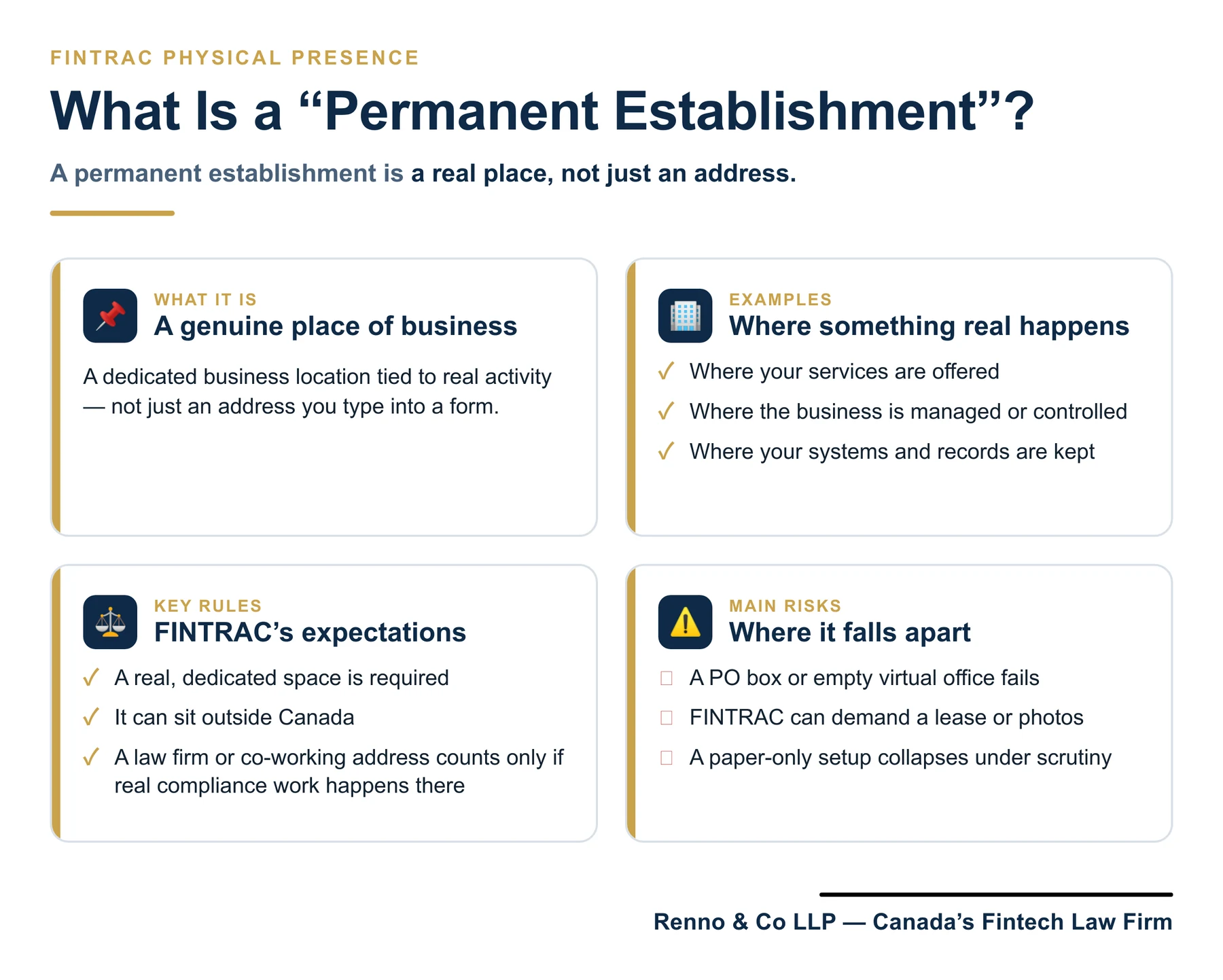
FINTRAC requires a permanent establishment: a real, dedicated physical space connected to your actual business, compliance, systems, or record-keeping, at which you are operating out of. FINTRAC has accepted a genuine foreign business address for a Canadian MSB, although this will lead to problems when you try onboarding with banks. What FINTRAC will not accept is a PO box or an empty virtual address with nothing real behind it.
Take a crypto-OTC and bulk-FX firm we’ll call AlpenFX (an anonymized example from our files). AlpenFX ran its operations out of Switzerland under a UK holding company and wanted a Canadian MSB mainly as a backup option. Its biggest worry was whether it needed a real Canadian office just to satisfy FINTRAC — and on that narrow question, the answer was no. AlpenFX’s genuine Swiss operating office could serve as its FINTRAC business address, because FINTRAC cares about real substance, not about whether the address is Canadian.
The problem showed up one step later. AlpenFX’s account providers — the banks and payment partners it needed to actually operate — were not willing to accept a foreign-only address, which threatened to leave the MSB registered but unable to get banked. That is why AlpenFX went with our Back-End AML Support (Basic): it gave the firm a Canadian office address it could list with both FINTRAC and its account providers, plus the ongoing compliance work that makes a law-firm address hold up. For a fuller walkthrough of the options, see our guide to Canadian MSB physical presence.
What is a “permanent establishment”?
A permanent establishment is a genuine, dedicated business location tied to real activity — not just an address you can type into a form. For FINTRAC, that means a place where your services are offered, where the business is managed or controlled, where your systems are maintained, or where client and transaction records are kept. The one thing every version has in common is substance: something real has to actually happen there.
That is why the label on the door matters less than what goes on behind it. FINTRAC can ask you to prove the location is real, so a strategy that looks fine on paper can still fail if there is nothing behind the address.
Can I use a PO box or virtual office?
For the FINTRAC business address, no. A PO box or empty virtual office has no real activity behind it, so it fails the permanent-establishment test. You can use a PO box or virtual address for your registered office address — the corporate-registry address that marks your company’s legal home — but do not confuse that with the business address FINTRAC lists publicly.
The two addresses do different jobs. The registered office address has to sit in your province of incorporation (an Ontario corporation needs an Ontario address, an Alberta corporation needs an Alberta address, and so on), and a corporate registry is generally fine with a PO box or virtual address there. The FINTRAC business address, by contrast, shows up on the public FINTRAC registry — which banks and partners can look up — so it needs to be a real place.
Can I use a law firm or compliance firm address?
Yes, in the right facts. FINTRAC allows a law firm’s or consultant’s address to be your FINTRAC business address if that firm actually carries out your business or compliance activities on your behalf. This is a genuine exception to the physical-presence expectation, not a loophole. A co-working space can work on the same logic — but only if real business, compliance, or record-keeping activity actually happens there.
This is exactly how a back-end AML or fractional AML arrangement can help you meet FINTRAC’s address requirements. When you retain us for our back-end AML services, we take the position with FINTRAC that we are a law firm conducting your compliance activities, and you use our Canadian address as your FINTRAC business address. This is the route AlpenFX ultimately took: our Canadian address gave it something both FINTRAC and its account providers would accept, backed by real compliance work rather than a paper-only setup. Just remember that this only holds up if the compliance work is genuinely being done.
To learn more about your address options and how we can help, see our fractional AML services for Canadian MSBs.
What if FINTRAC asks where operations actually happen?
Be ready to prove it. FINTRAC may request a lease agreement, photos of the space, or other documents showing the location meets the definition of a place of business. If you rely on a law firm or compliance provider, that provider should be genuinely performing compliance work for you. A thin, paper-only setup is the most common way an otherwise acceptable address strategy falls apart — so build the substance before you list the address, not after FINTRAC asks.
What address options do Canadian MSBs actually use?
In practice, MSBs choose from four address strategies. The right one depends on whether you already operate abroad, whether you have Canadian staff, and how much compliance help you need. The table below compares them.
| Address strategy | How it works | Approx. monthly cost | Best for | Issues with approach |
|---|---|---|---|---|
| Use your own foreign office | How it worksUse your real overseas office as the FINTRAC business address; keep a simple Canadian registered office (a PO box is fine here) | Approx. monthly costNo new cost | Best forMSBs with solid banking that do not need Canadian presence | Issues with approachMuch harder to onboard with account providers (banks/PSPs) without a real Canadian physical presence. |
| Law firm / compliance provider address (back-end AML) | How it worksRetain a provider for ongoing compliance, use their Canadian address for FINTRAC, and get proof of address for your bank | Approx. monthly cost~$950–$2,500 USD | Best forNo Canadian staff, but you have an internal compliance team | Issues with approachOngoing monthly fees, roughly ~$950–$2,500 USD depending on the service level. |
| Fully outsourced (fractional) AML, including address | How it worksA provider runs your compliance program, acts as your compliance officer, and gives you a Canadian address | Approx. monthly cost~$2,000–$5,000 USD | Best forYou need real compliance support and a Canadian compliance officer | Issues with approachThe most expensive option, typically ~$2,000–$5,000 USD per month. |
| Rent your own Canadian office | How it worksLease your own private office and take the position that you operate from it | Approx. monthly cost~$400 USD | Best forCompanies that have, or will put, staff in a Canadian office | Issues with approachWithout people actually staffing the Canadian office, you have no real physical presence, and account providers can push back during onboarding. |
AlpenFX fit the first two rows: its Swiss office satisfied FINTRAC, but the law-firm/compliance-provider route was attractive because it also supported the physical presence requirements that account providers expect. Whichever route you pick, remember you still need a registered office address in your province of incorporation.
Why your bank cares about your address more than FINTRAC does
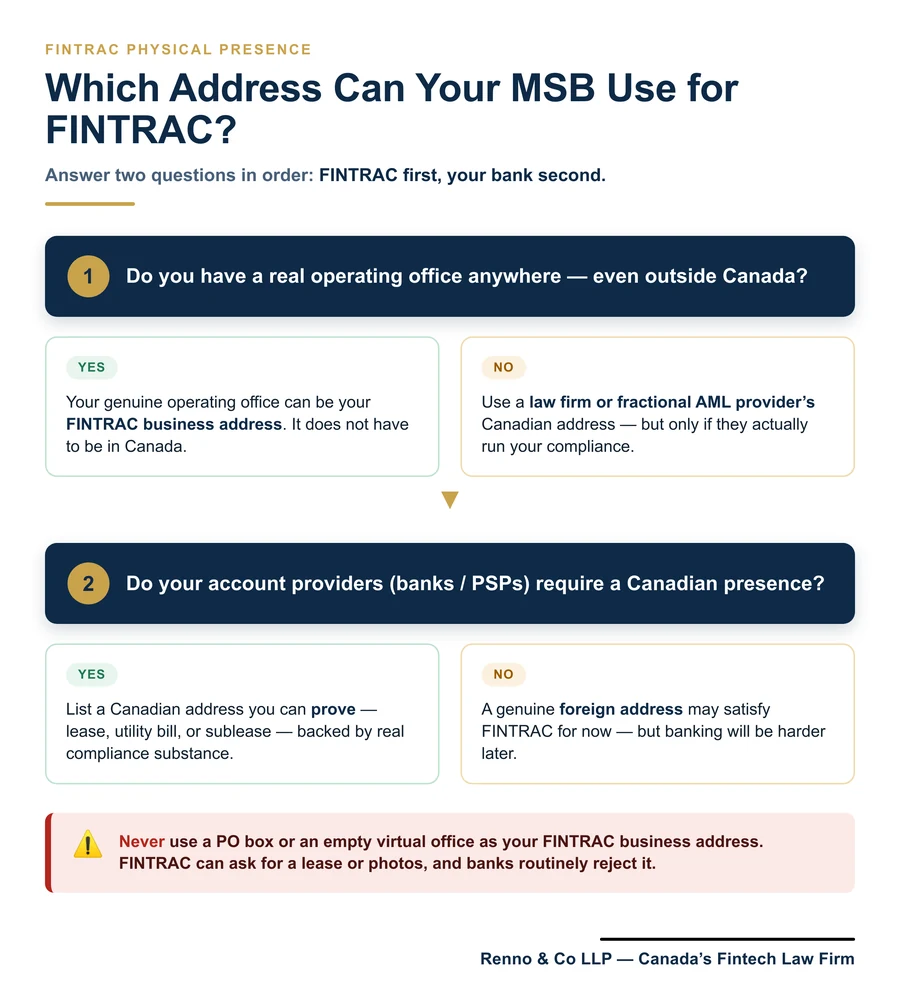
Even when FINTRAC accepts a foreign or law-firm address, your account providers (banks, payment firms, and similar partners that give you an account) often will not. Many expect a legitimate Canadian operating address backed by proof — a lease, a utility bill, or a sublease — plus a credible, well-staffed compliance function. PO boxes and virtual offices are routinely rejected. So your address strategy is really two questions at once: what passes FINTRAC, and what gets you banked.
This matters because banking is one of the hardest parts of launching an MSB. Account providers increasingly want to see Canadian physical presence and Canadian AML/compliance expertise before they onboard you. Getting registered is only half the battle — you still need banking or payment rails in place before you can go live. Book a call to learn more about how we can provide you an address that will keep FINTRAC and banks happy. If you want to understand the banking side first, see how we help clients open bank accounts in Canada.
Get your address strategy right before you file
The address you list is one of the first things FINTRAC lists publicly and one of the first things a bank checks. A weak or mismatched address can slow your registration and sink your banking application. Before you put any address on your Canadian MSB registration, book a call with Renno & Co to map the right address strategy for your structure, your jurisdiction, and your banking plan.
Disclaimer: This content is for informational purposes only and does not constitute legal advice.
Ready to get started?
Talk To UsBook a Free Consultation
Speak with our fintech legal advisor
about your registration


