


Our mission is to help Canadian fintech companies get registered, go live, and stay compliant.
If your business moves money or crypto for other people and has a real connection to Canada (which includes Canadian-incorporated companies), the safe assumption is that you need MSB registration before you launch. Most payment, foreign exchange, remittance, and crypto businesses fall into this bucket, and you generally cannot legally operate — or get a Canadian bank account — until you are registered.
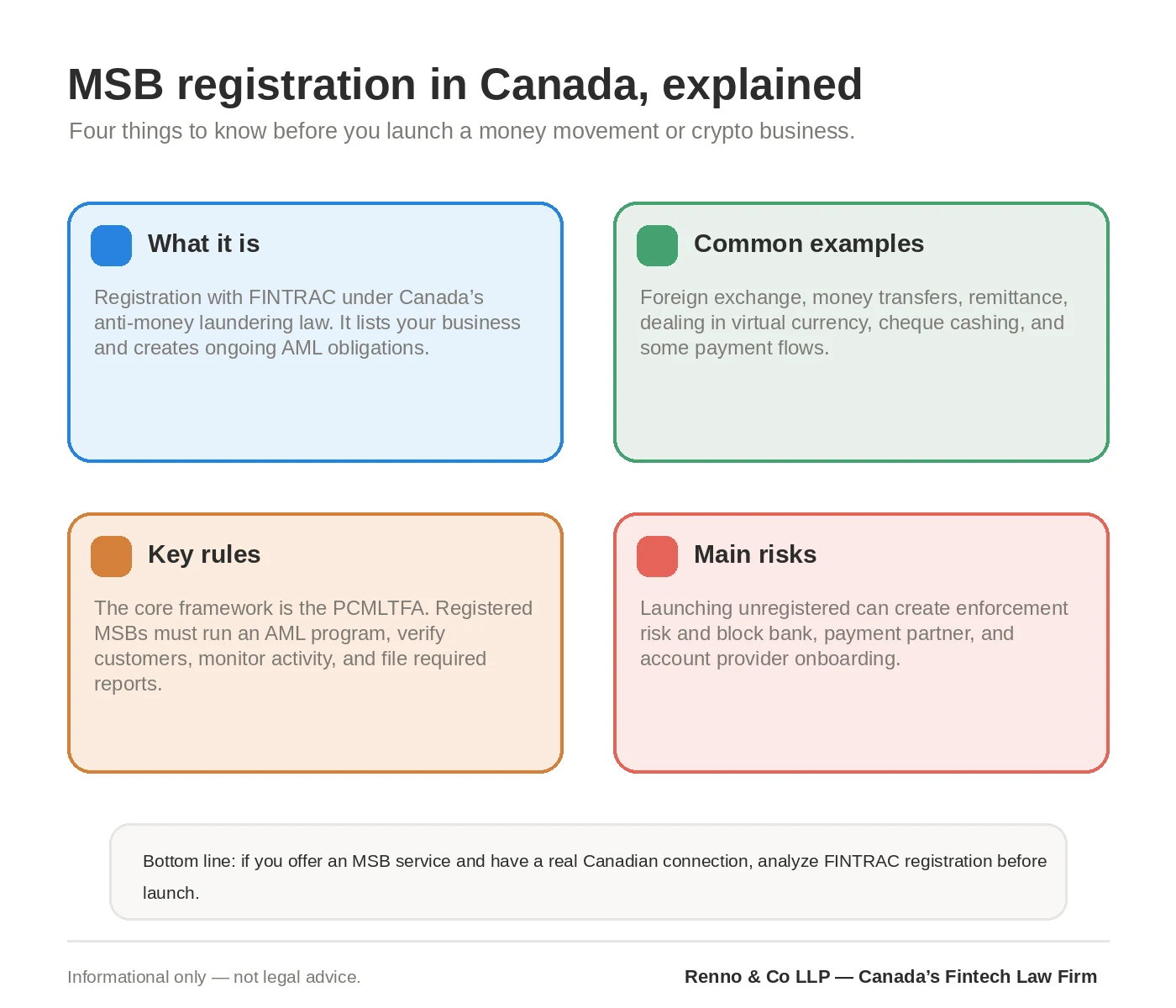
A money services business (MSB) is a business that provides services such as foreign exchange, transferring money, dealing in virtual currency, or cheque cashing. In Canada, these businesses must register with FINTRAC, the federal agency that fights money laundering and terrorist financing, before offering services to the public. This is a registration, not a licence — FINTRAC lists you and holds you to anti-money laundering rules; it does not approve or vouch for your business.
If you want a direct read on whether you need MSB registration for your own model, you can book a call with our team.
On this page
What MSB registration in Canada actually means
MSB registration is the process of listing your business with FINTRAC under Canada's anti-money laundering law, the Proceeds of Crime (Money Laundering) and Terrorist Financing Act (PCMLTFA). Once registered, your business appears on FINTRAC's public registry and must follow ongoing anti-money laundering rules. Registration confirms you are listed and regulated — it does not mean FINTRAC has approved, endorsed, or vetted your business model.
This matters for two practical reasons. First, operating without registration is not legal for money services business activities. Second, banks and other account providers treat a valid FINTRAC registration as the bare minimum before they will even consider onboarding you, so registration is what makes your business real and bankable in Canada.
Who needs to register with FINTRAC?
You need to register if you offer at least one money services business service and you have a place of business in Canada. You also need to register if you are based abroad but direct your services at people in Canada and serve Canadian clients. In short: an MSB activity plus a real Canadian connection triggers registration with FINTRAC.
The two-part test for a Canadian MSB
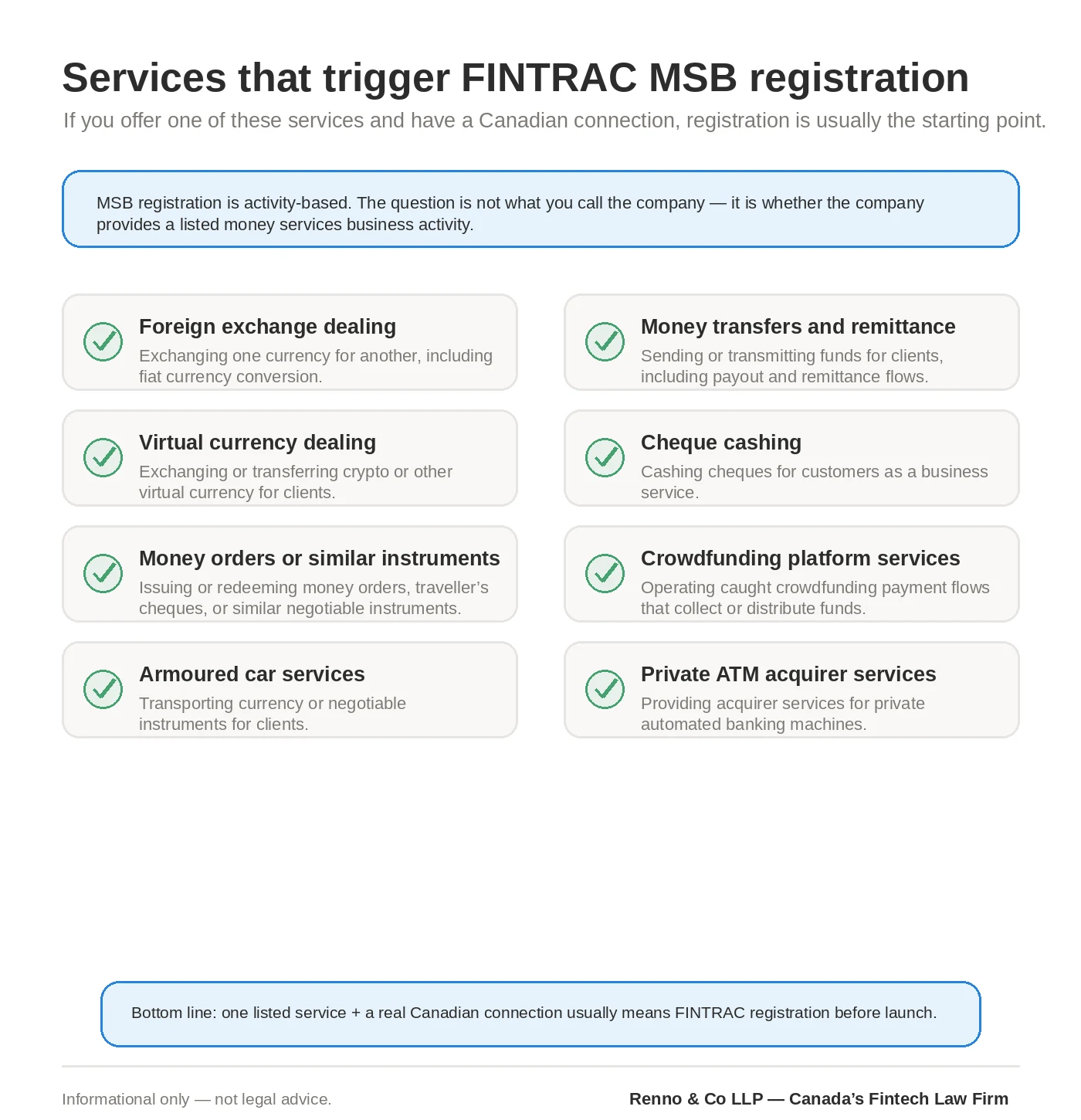
You are a money services business if both parts are true. Part one is that you offer at least one of these services:
- Foreign exchange dealing (exchanging one currency for another)
- Remitting or transmitting funds (money transfers and remittance)
- Issuing or redeeming money orders, traveller's cheques, or similar instruments
- Dealing in virtual currency (both exchanging and transferring crypto)
- Cheque cashing
- Crowdfunding platform services
- Transporting currency or negotiable instruments (armoured car services)
- Acquirer services for private automated banking machines
Part two is that you have a place of business in Canada. Under FINTRAC's test, that means you are incorporated in Canada, have a physical location in Canada, or have employees, agents, or branches in Canada.
What if my business has 0 connection to Canada (and is not incorporated in Canada)?
You can still be caught as a foreign money services business (FMSB). This applies when you have no place of business in Canada but you direct your services at people in Canada and provide services to Canadian clients. FINTRAC treats you as “directing services at Canada” if your marketing targets Canada, you operate a “.ca” domain, or you are listed in a Canadian business directory.
There is one narrow relief here called reverse solicitation. If you are not actively marketing to Canadians, you may avoid a Canadian connection even if you occasionally serve a Canadian client. Be careful with this: reverse solicitation only helps for MSB purposes. It does not apply to RPAA registration or securities registration.
Does a crypto, FX, or remittance business need MSB registration?
Yes. Foreign exchange, money transfers and remittance, and dealing in virtual currency are all core MSB activities, so these businesses almost always need MSB registration if they have a Canadian connection. Crypto is captured as “dealing in virtual currency,” which covers both exchanging and transferring virtual currency. Cheque cashing and merchant payment processing are usually caught too.
Many of these businesses also need a second registration. If you help clients send or receive electronic funds, you may also need to register as a payment service provider (PSP) with the Bank of Canada under the Retail Payment Activities Act (RPAA) — a separate law focused on operational risk and protecting customer funds. The table below shows the common models.
| Business model | MSB registration | Often also needs RPAA registration |
|---|---|---|
| Foreign exchange / currency exchange | ✅ | ❌ |
| Money transfer / remittance | ✅ | ✅ |
| Dealing in virtual currency (non-custodial) | ✅ | ❌ |
| Merchant pay-in / payment processing | ✅ | ✅ |
| Payout products | ✅ | ✅ |
| Cheque cashing | ✅ | ❌ |
| Payment processor | ✅ | ✅ |
| Payment service provider | ✅ | ✅ |
One caution: if you hold customer crypto or offer a product that promises returns, you can also trigger provincial securities registration, which is much heavier and slower. If your model has either feature, or if your product is captured by the above checklist, get advice on your RPAA registration and securities exposure early, before you build.
Take a real example. An overseas payments group we'll call Meridian Pay came to us wanting to run merchant payment processing for the Canadian market. That model sits squarely in the table above: they needed MSB registration, and because they were helping others move funds, RPAA registration too. Their harder problem was not whether they had to register — it was how fast they could actually go live, which we come back to below.
Can I operate before FINTRAC registration is done?
Generally no. You cannot provide money services business services until your FINTRAC registration is complete, which usually takes about 4 to 6 months. Launching first and registering later is not an option for MSB activities. One shortcut exists: buying a ready-made, already-registered MSB, which can let you start in roughly a week because FINTRAC only needs to be notified of a change in ownership, not asked to approve it.
This is the route the overseas payments group introduced above — Meridian Pay — ultimately weighed. After earlier providers quoted them 11 to 18 months to register from scratch, they looked at buying a clean, already-registered MSB instead, so FINTRAC only had to be notified of a change in ownership rather than approve a brand-new applicant, which can compress the wait to roughly a week or two.
How long does MSB registration take?
As a planning rule, budget about 5 months to complete MSB registration. Build your go-live date around that timeline rather than assuming you can start once the application is filed. If speed is critical, buying a ready-made MSB is the main way to compress that wait.
For clarity, we have a few key contacts with Managers in FINTRAC's MSB Registration Unit that allows us to escalate MSB registrations that have been in the pipeline for a while (which allows our clients' registrations to get processed faster). We are hearing from market that folks initiate their MSB registration themselves take 9+ months to complete.
Do I also need RPAA registration?
If you run a remittance, pay-in, or payout product, you likely also need RPAA registration as a PSP with the Bank of Canada. That process is longer — roughly 6 to 12 months — but you can run it in tandem with your MSB application. Note that buying a ready-made RPAA-registered entity is much harder, because the Bank of Canada must approve a change in ownership. You can review the Bank of Canada's criteria for registering payment service providers for more detail. For a side-by-side comparison of the two regimes, see our guide to MSB vs. RPAA registration in Canada.
What about banking?
Keep in mind that getting registered is only half the battle! You'll need to get banking / payment rails in place before you can go live. We are connected with a network of banks and account providers and have helped a variety of clients get banked in the past. See here to learn more!
What happens if I launch too early?
If you operate before you are registered, you are offering regulated services without authorization, which creates real enforcement risk — especially when Canadian users are affected. Just as important, Canadian banks and payment partners will not onboard an unregistered money services business, so you effectively cannot run your flows. Launching early usually blocks you rather than speeds you up.
In practice, your account providers and partners will ask for proof of registration during onboarding and due diligence. Missing registrations are treated as a compliance blocker, not a paperwork detail, and they can stall a launch far longer than the registration itself would have taken.
Ongoing obligations after you register
Registration is the starting line, not the finish line. Once registered, you must run an anti-money laundering (AML) compliance program and keep it current. That means identifying your customers, monitoring transactions, reporting certain transactions to FINTRAC, and getting an independent effectiveness review of your program on a regular schedule (often every two years).
At a high level, your ongoing MSB obligations include:
- Identifying and verifying customers (KYC), and keeping that information current
- Monitoring transactions and investigating red flags
- Filing required reports, such as suspicious transaction reports, large cash transaction reports, large virtual currency transaction reports, and electronic funds transfer reports
- Maintaining written AML policies, procedures, and a risk assessment
- Training staff who onboard customers or move money
- Completing an independent effectiveness review of your program on schedule
For the full picture of what applies once you are registered, FINTRAC's guidance for money services businesses is the starting point.
When to start, and your next steps
Start before you lock in a launch date. Because MSB registration takes about 5 to 6 months — much longer if you file it yourself — and RPAA registration can take even longer, the registration analysis should be one of the first things you do, not the last. Early on, you can also decide whether to register directly, buy a ready-made MSB to move faster, or restructure your model to remove a trigger you do not need.
That is exactly the decision Meridian Pay faced. Because a fresh registration ran far longer than their launch window, they treated the timeline as the first thing to solve, weighing a from-scratch registration against buying a ready-made MSB. The lesson for readers: settle this early, because registering from scratch and buying an already-registered entity answer the same “when can I start” question in very different ways, and the right path depends on how quickly you need to go live.
If you are planning to register as an MSB in Canada, book a call to review your model, your registration triggers, and your timeline before you file or launch. If you also handle pay-ins or payouts, we can map your MSB registration and RPAA registration together so the two timelines line up.
Disclaimer: This content is for informational purposes only and does not constitute legal advice.


