


Our mission is to help Canadian fintech companies get registered, go live, and stay compliant.
You usually need AML consulting because Canada's rules are intricate and overlapping, so you want people on the ground here who work with them every day. Many of these are really legal questions about how the law applies to your model, not just operational ones, so it helps to have a lawyer in the room and not only an operational consultant. That matters even more when your fintech is based outside Canada, as most of the companies we help are. A consultant explains how Canada's regimes actually apply to your model — anti-money laundering (AML) law, retail payments oversight by the Bank of Canada under the Retail Payment Activities Act (RPAA), and securities regulation — and helps you work through hard, specific questions: whether a particular flow of funds is allowed, how much enhanced due diligence an unusual client file needs, or how a new product changes your obligations. It is specialist advice on a defined question, with a concrete answer at the end. It is not a legal requirement on its own, and it does not replace your own compliance team.
A quick definition: a money services business (MSB) is a business that transfers money, exchanges currency, deals in virtual currency, or provides similar services, and most must register with FINTRAC, Canada's anti-money laundering regulator. Registration lists you as a reporting entity and switches on ongoing obligations; it is not a licence or a stamp of approval. Many fintechs bring in a consultant proactively. Take a fintech we'll call Northaxis Finance, a Canadian MSB whose major banking partners wanted proof of a solid program, so it sought outside help early rather than waiting for something to break.
What does an AML consultant do for a Canadian fintech or MSB?
An AML consultant gives you time-limited, specialist advice on a defined problem. Typical work includes a risk or gap assessment, interpreting how Canada's overlapping regimes (AML, RPAA, securities, and Bank of Canada rules) apply to your model, answering a hard control question such as whether a specific flow of funds is permitted or how much enhanced due diligence an unusual file needs, drafting or fixing part of your AML program, and delivering a concrete output such as a remediation plan or a reviewed risk assessment. It is project work with a start and an end. It is not your day-to-day know-your-customer (KYC), transaction monitoring, or reporting.
That distinction matters commercially. Running controls every day is an operations job, while a consulting mandate answers a question or fixes a defined problem and then closes out. If what you actually need is a drafted or rebuilt program, that is a defined project too, and our AML policies and risk assessment service covers it. The seven situations below are the ones that most often justify bringing in specialist advice.
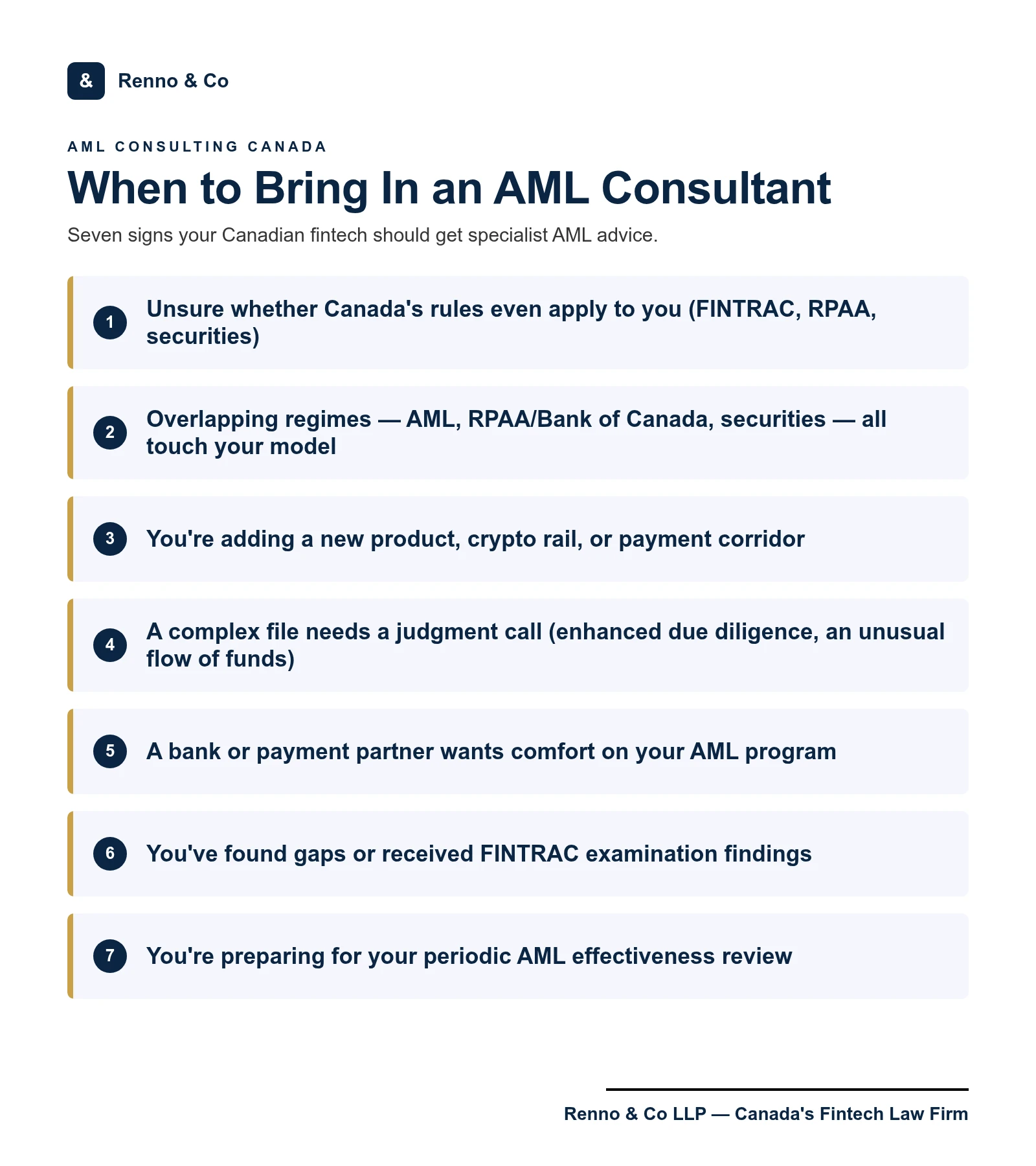
Seven signs a Canadian fintech should get specialist AML advice.
When should you get AML advice before you launch?
Get AML advice before launch when you are unsure whether you are even a reporting entity, how to classify your activities, or whether your written controls match what you actually plan to do. Not every fintech is automatically a FINTRAC reporting entity, and being a payment service provider under the Retail Payment Activities Act (RPAA) does not by itself make you one. A short engagement can confirm your obligations before you build the wrong program.
These are separate regimes, so assess your actual activities against each one rather than assuming one registration answers the other.[1] If registration is clearly part of the picture, start there with our MSB registration service and our guide to the FINTRAC MSB registration process, and keep RPAA registration as a distinct question. Registration lists you with FINTRAC; it is not a general operating licence or a guarantee of approval.
When should you bring in a consultant because a bank or payment partner has concerns?
Bring in a consultant when a bank or payment partner asks for clearer policies, a defensible risk methodology, better KYC documentation, or specific corrective action. These requests can stall onboarding or put an existing account at risk, and a credible, well-documented response is what moves them. Targeted advice helps you produce that response. It improves your program and your answer, but it cannot guarantee that a partner will onboard or keep you.
This is where many fintechs first feel the pressure. Account providers increasingly expect a real Canadian presence and a working AML program before they will give comfort, and FINTRAC itself often expects meaningful Canadian physical presence. That is exactly what pushed Northaxis to act early: its partners wanted proof, not promises. If a partner is asking hard questions about your setup, book a call to review what they need and how to close the gap.
What if you find serious AML gaps or receive FINTRAC examination findings?
If you find serious gaps, or FINTRAC examination findings land on your desk, you need a remediation plan rather than a scramble. A consultant helps you scope the fixes, assign owners, set deadlines, and build evidence that you actually implemented them. The goal is a documented, defensible response to the specific problems in front of you. There is also a quiet advantage to running this through a lawyer: when you write down your own weaknesses, advice from a lawyer can be covered by solicitor-client privilege, which helps keep a candid self-assessment from being turned against you later.
Keep the focus on fixing the issues, not on re-running an examination. A scoped gap assessment and remediation project can repair policies, KYC files, or your risk assessment, and our AML policies and risk assessment service handles the rebuild where a program needs real work.
Do you need AML consulting before an effectiveness review?
Sometimes. An AML effectiveness review is the independent review FINTRAC expects reporting entities to complete on a set schedule, often every two years, and a qualified internal or external reviewer can carry it out.[1] You do not always need separate consulting first. But if you want to walk in ready, a short readiness check can surface gaps before the reviewer does.
That is the Northaxis story in practice. Soon after registering, and under pressure from its banking partners, it wanted to be ready for a review that closely mirrors a FINTRAC examination: a request for information covering the AML policy, a sample of transactions, a sample of KYC files, and a sample of filed reports, plus interviews with the team. Note the distinction, though: a voluntary gap assessment is not automatically the statutory review. For scope, timing, and process, see our AML audit and effectiveness review service and our article on AML effectiveness review expectations.
When is one-time AML consulting enough, and when do you need an outsourced AML team?
Choose one-time consulting for a discrete problem, decision, or project. Choose ongoing, outsourced AML support when you need continuous coverage: a standing compliance-officer function, daily KYC, transaction monitoring, and reporting. The simple test is whether this is a decision or a fix, or an operation that has to run every day.
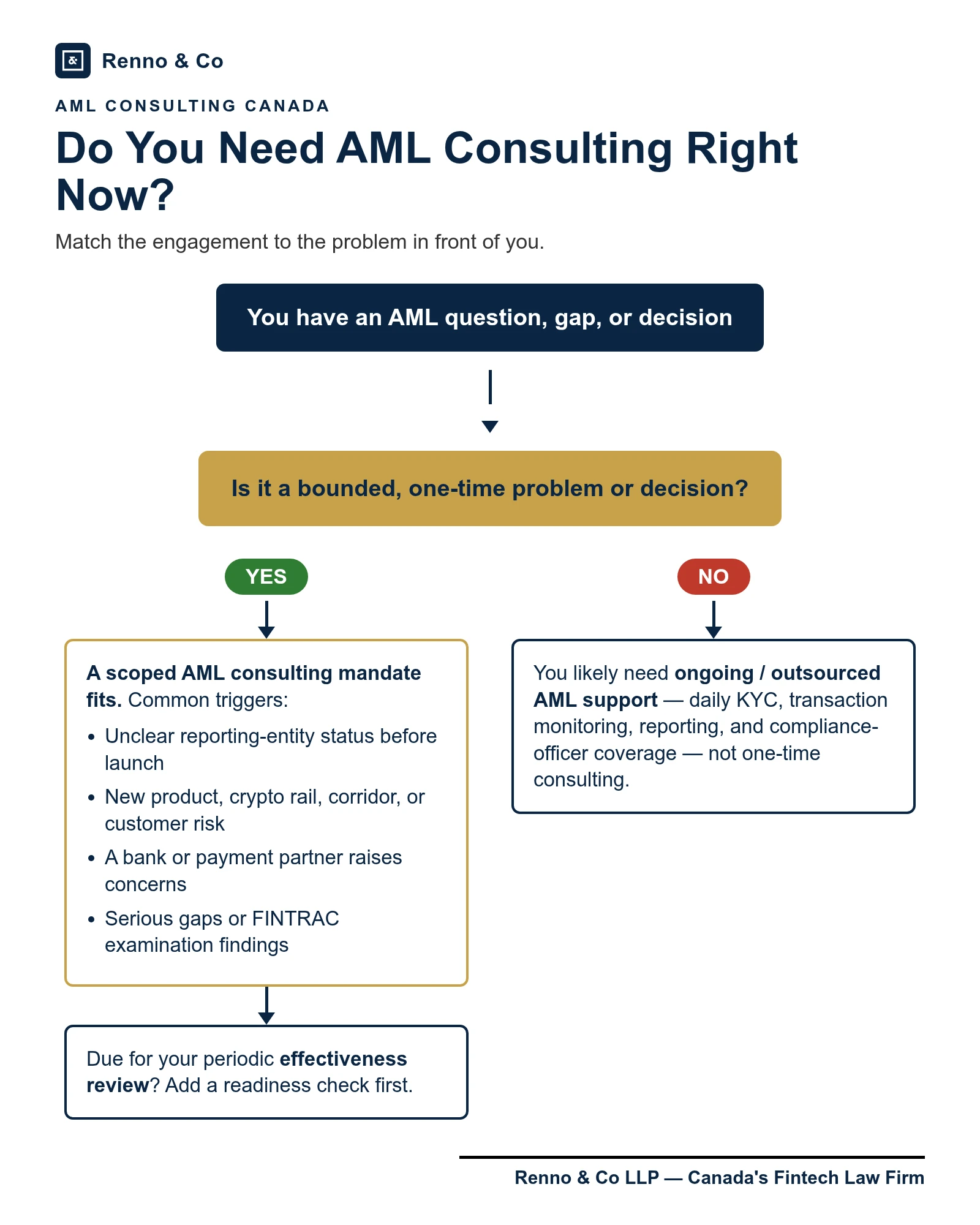
Decision tree: match the engagement to the problem in front of you.
If you need the operation run for you, that is fractional AML, not consulting. One more point: a consultant's advice does not appoint or replace your required compliance officer, who remains your own responsibility. For that role, see MSB compliance officer requirements and what an AML officer does.
What should you prepare before speaking with an AML consultant?
Bring the basics so the first conversation is productive: your business model and flow of funds, your registration status, your current AML policies and risk assessment, a few sample controls or records, and a clear statement of the specific decision or deficiency you are facing. The sharper the problem, the tighter and cheaper the mandate.
- Business model and flow of funds
- Registration status (MSB, RPAA, and any others)
- Current AML policies and risk assessment
- Sample controls or records
- The specific decision or gap you need solved
Frequently asked questions
Is hiring an AML consultant legally required in Canada? No. FINTRAC requires a compliant program from reporting entities; it does not require you to hire an external consultant. The obligation, and the accountability, stay with you.
Can an AML consultant replace our FINTRAC compliance officer? No. Advice alone does not appoint or replace the compliance officer you must have, and your business remains responsible for its program.
Can a consultant decide whether a transaction needs a suspicious transaction report? A specialist can help you interpret a hard case, but you must apply the legal threshold and your own processes. A red flag does not automatically require a report.
Should your AML consulting come from a lawyer? Not always, but it often helps. Much of this work turns on how Canada's laws apply to your model, and advice from a lawyer can carry solicitor-client privilege and extra weight with regulators and banking partners. That is why our AML work sits inside a fintech law practice, not a standalone consultancy.
Have a specific AML gap, a bank asking hard questions, or a product change on the way? Book a call or fill out our form, and we'll help you scope a targeted AML advisory mandate around the exact problem you're facing.
This content is for informational purposes only and does not constitute legal advice.
Ready to get started?
Talk To UsBook a Free Consultation
Speak with our fintech legal advisor
about your registration


